4-Hydroxybenzoic Acid → 4-(4-Methoxycinnamoyloxy)-Benzoic Acid
Reaction equation

[CH3:1][O:2][C:3]1[CH:13]=[CH:12][C:6]([CH:7]=[CH:8][C:9](Cl)=[O:10])=[CH:5][CH:4]=1.C(N(CC)C(C)C)(C)C.[OH:23][C:24]1[CH:32]=[CH:31][C:27]([C:28]([OH:30])=[O:29])=[CH:26][CH:25]=1>N1C=CC=CC=1.CN(C)C1C=CN=CC=1>[CH3:1][O:2][C:3]1[CH:13]=[CH:12][C:6]([CH:7]=[CH:8][C:9]([O:23][C:24]2[CH:32]=[CH:31][C:27]([C:28]([OH:30])=[O:29])=[CH:26][CH:25]=2)=[O:10])=[CH:5][CH:4]=1Participants
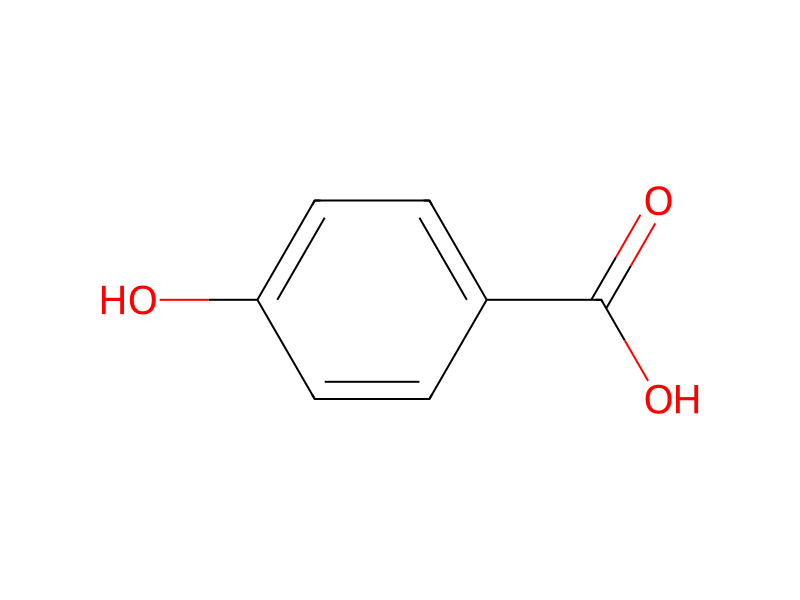





Procedure
This step illustrates the addition of an aryl group to the compound of Step 2 to increase the stiffness and rod-like characteristics of the alkyl or alkoxy substituted cinnamoyl group. The compound of Step 2 (1.0 gm=5.1 mmole) was slurried under N2 in 10 mL dry pyridine. N,N-diisopropylethylamine (0.7 gm=5.6 mmole) was added, followed by a spatula tip of 4-dimethylaminopyridine. A solution of p-hydroxybenzoic acid (0.7 gm, 5.1 mmole) in 7 mL pyridine was added dropwise to the above slurry. An amber-orange solution soon developed. The solution was stirred for 60 minutes after addition was complete, and it was dropped slowly into 200 ml ice/H2O containing 25 mL concentrated HCl. The resulting precipitate was collected by suction filtration, slurried twice with H2O on the funnel, and dried in a 40° C. vacuum oven. The white solid was recrystallized from boiling acetone. White needles, K280° l.c. Yield 0.6 gm. Elemental Analysis: C17H14O 5, mol. wt. 298.3. Calcd: C, 68.5, H, 4.7, O, 26.8. Found: C, 68.5, H, 4.7. 1H NMR (DMSO-d6): δ (ppm) 6.7 (1H, d), 8.0 (1H, d).
Workup
- additionafter addition
- filtrationThe resulting precipitate was collected by suction filtration
- customdried in a 40° C. vacuum oven
- customThe white solid was recrystallized
Sources & evidence
- ORD record
- ord-7bd32a7f7a4d4fb8959b74bc5c17d574
- Source dataset
- uspto-grants-1987_09
- Patent number
- US04696990
Reaction notes
Loading…