Nitric Acid → 3-Bromo-4-fluorobenzaldehyde
Reaction equation

[Br:1][C:2]1[CH:3]=[C:4]([CH:7]=[CH:8][C:9]=1[F:10])[CH2:5][OH:6].[N+]([O-])(O)=O.[OH-].[Na+]>O>[Br:1][C:2]1[CH:3]=[C:4]([CH:7]=[CH:8][C:9]=1[F:10])[CH:5]=[O:6]Participants
5
Reactant 3


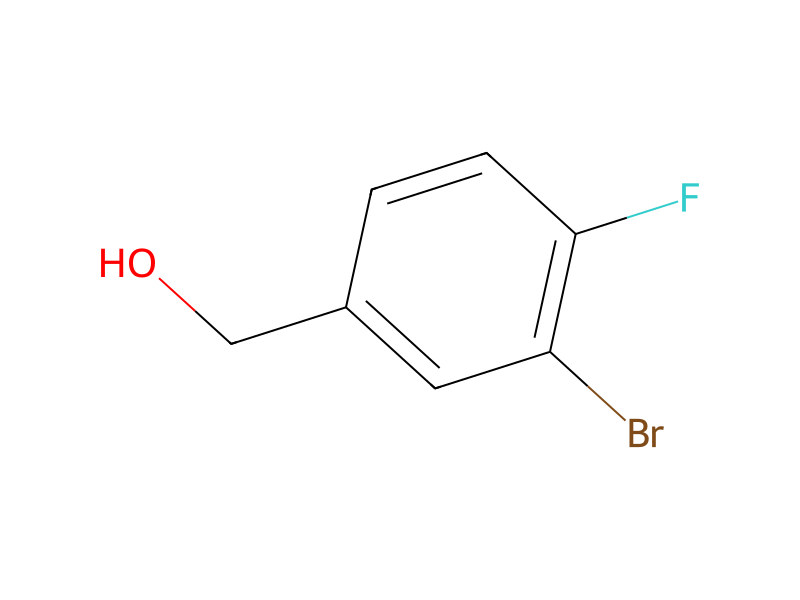
Product 1

Reagents, catalysts & solvents 1

Procedure
10.2 g (0.05 mol) of 3-bromo-4-fluoro-benzyl alcohol were added to a mixture of 10 g of nitric acid (density: 1.4) and 5 ml of water at 30°-35° C. and the mixture was then stirred at room temperature for 5 hours. After adding 30 g of ice, sodium hydroxide solution was added to the mixture until the pH value reached 13, and the mixture was then extracted by shaking with 200 ml of toluene. The organic phase was washed three times with 50 ml of water each time, dried over sodium sulphate and then evaporated. The residue was distilled. 6.1 g (60% of theory) of 3-bromo-4-fluoro-benzaldehyde were thus obtained in the form of an oil which slowly solidified and had a melting point of 29°-31° C.
Workup
- additionwas added to the mixture until the pH value
- extractionthe mixture was then extracted
- stirringby shaking with 200 ml of toluene
- washThe organic phase was washed three times with 50 ml of water each time
- dry with materialdried over sodium sulphate
- customevaporated
- distillationThe residue was distilled
Sources & evidence
- ORD record
- ord-26f897e62d8f4f3bb4525cd3a98f97ae
- Source dataset
- uspto-grants-1989_07
- Patent number
- US04845249
Reaction notes
Loading…