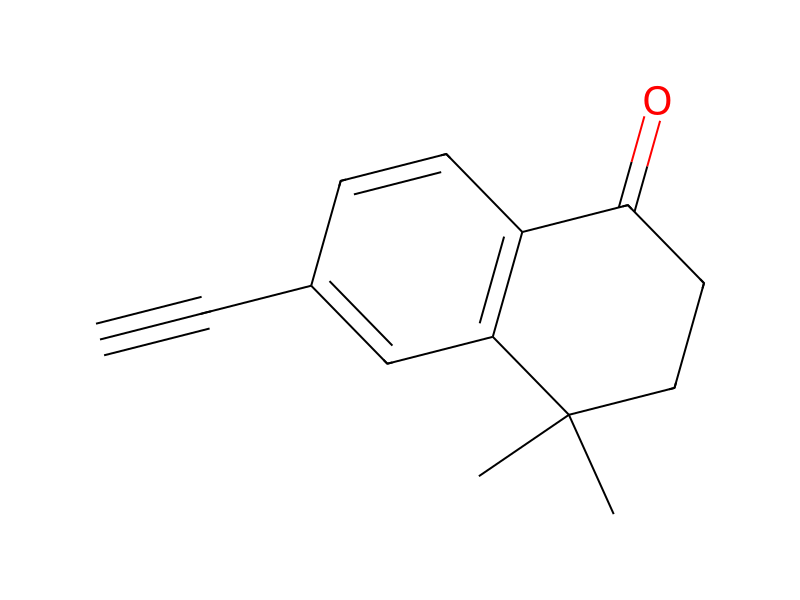
6-ethynyl-3,4-dihydro-4,4-dimethylnaphthalen-1(2H)-one → HCID 22412537, compound
Reaction equation

[C:1]([C:3]1[CH:4]=[C:5]2[C:10](=[CH:11][CH:12]=1)[C:9](=O)[CH2:8][CH2:7][C:6]2([CH3:15])[CH3:14])#[CH:2].Br[C:17]1[CH:18]=[C:19]2C(=[CH:25][CH:26]=1)C(=C(CC)CC)CCC2(C)C>>[C:1]([C:3]1[CH:4]=[C:5]2[C:10](=[CH:11][CH:12]=1)[C:9](=[C:17]([CH2:18][CH3:19])[CH2:26][CH3:25])[CH2:8][CH2:7][C:6]2([CH3:15])[CH3:14])#[CH:2]Participants
3


Procedure
Employing the same general procedure as for the preparation of 6-ethynyl-3,4-dihydro-4,4-dimethylnaphthalen-1(2H)-one (Compound K), 530 mg (1.66 mmol) of 6-bromo-3,4-dihydro-1(2H)-(3-pentylidene)-4,4-dimethylnaphthalene (Compound Q) was converted into the title compound using 1.63 g (16.6 mmol) of trimethylsilylacetylene, 20 mg (0.08 mmol) of cuprous iodide, 60 mg (0.08 mmol) of bis(triphenylphosphine)palladium(II) chloride and 40 mg (0.3 mmol) of potassium carbonate.
Sources & evidence
- ORD record
- ord-057bae7cfdb64c7d847aec80d2945294
- Source dataset
- uspto-grants-1997_01
- Patent number
- US05591858
Reaction notes
Loading…