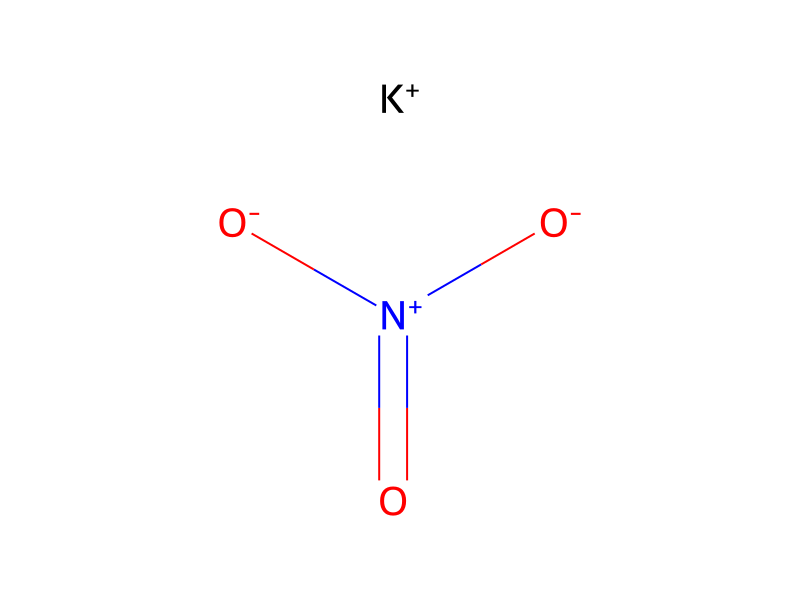
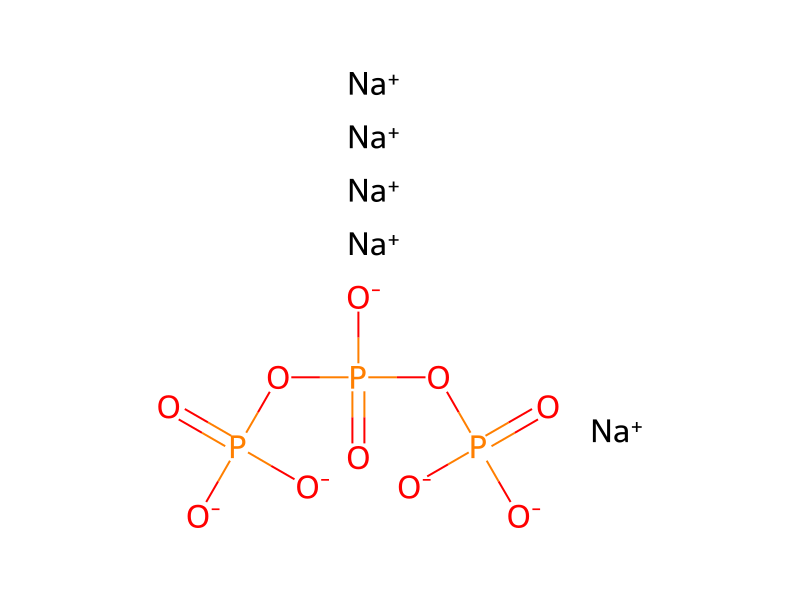
Potassium Nitrate → Tetrasodium Pyrophosphate
Reaction equation

[O-:1][P:2]([O:5][P:6]([O:9][P:10]([O-:13])([O-:12])=[O:11])([O-:8])=[O:7])([O-:4])=[O:3].[Na+:14].[Na+].[Na+].[Na+].[Na+].C(=O)(O)O.[Na+].C(=O)([O-])[O-].C(=O)(O)O.[Na+].[N+]([O-])([O-])=O.[K+]>>[O-:3][P:2]([O:5][P:6]([O-:9])([O-:8])=[O:7])([O-:4])=[O:1].[Na+:14].[Na+:14].[Na+:14].[Na+:14].[O-:13][P:10]([O:9][P:6]([O:5][P:2]([O-:4])([O-:3])=[O:1])([O-:8])=[O:7])([O-:12])=[O:11].[Na+:14].[Na+:14].[Na+:14].[Na+:14].[Na+:14]Participants


Procedure
A stock mixture was made by mechanically blending 366 grams of STPP with 73 grams of sodium sesquicarbonate and 4.50 grams of KNO3. Two samples were taken from the mixture; one was milled in a lab pulverizing mill to approximately 100%-150 μm sieve and the other was left "as is". Both samples were calcined in a lab muffle furnace for one hour at 650° C. Assay of the samples showed that all the STPP in the milled sampled reacted with the sodium sesquicarbonate ("sesqui") to yield a calcined product with 98.9% TSPP and 1.1% metaphosphate whereas only 80% of the STPP reacted in the unmilled sample to yield a calcined product with 1.4% orthophosphate, 79.7% TSPP and 18.9% STPP. This example illustrates the importance of using a solid alkali which can be easily mixed with the solid STPP and further homogenized by milling.
Workup
- customone was milled in a lab
- waitthe other was left "
- aliquotsampled
Sources & evidence
- ORD record
- ord-0293e38b4f204b90970ac3ea22abc155
- Source dataset
- uspto-grants-1989_10
- Patent number
- US04873068
Reaction notes
Loading…