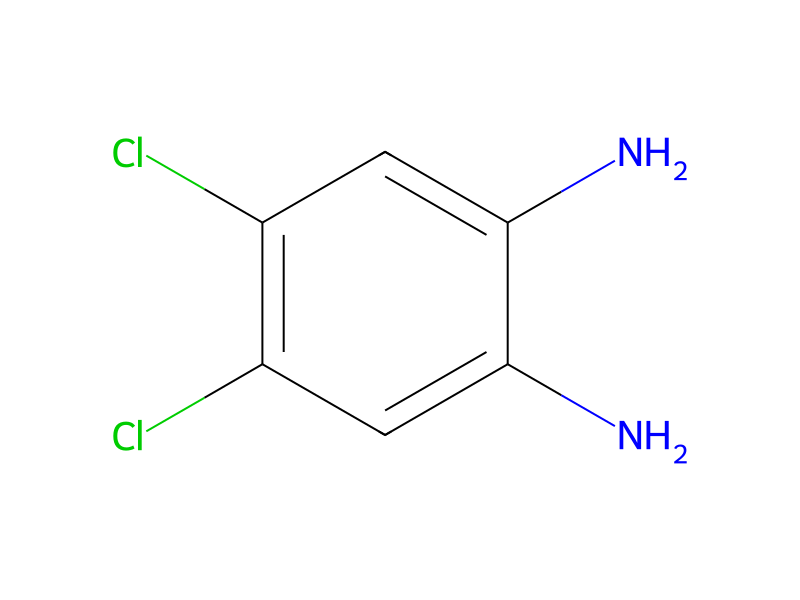
4,5-Dichloro-1,2-phenylenediamine → 6,7-dichloro-3-aminoquinoxalin-2(1H)-one
Reaction equation

[Cl:1][C:2]1[C:7]([Cl:8])=[CH:6][C:5]([NH2:9])=[C:4]([NH2:10])[CH:3]=1.[C:11]([O:16]CC)(=S)[C:12]([NH2:14])=O>C(O)C>[Cl:1][C:2]1[CH:3]=[C:4]2[C:5](=[CH:6][C:7]=1[Cl:8])[NH:9][C:11](=[O:16])[C:12]([NH2:14])=[N:10]2Participants
Reactant 2

Product 1

Reagents, catalysts & solvents 1

Conditions
- Temperature
- 25 °C
Procedure
An adaptation of the method of Burrell et al., J. Chem. Soc. Perkin I. 2707 (1973), was used. A mixture of 4,5-dichloro-1,2-phenylenediamine (354 mg, 2.00 mmol; Aldrich Co.) and ethyl thiooxamate (333 mg, 2.50 mmol; Aldrich Co.) in 5 mL of ethanol was heated to reflux. The resulting brown solution was stirred under reflux for 10 h. The resulting brown suspension was cooled down to 25° C. A brown precipitate appeared. The mixture was vacuum filtered and the brown solid was washed with EtOH (5×2 mL) and dried in vacuum at 60° C. overnight to yield 92 mg (20%) of 6,7-dichloro-3-aminoquinoxalin-2(1H)-one: mp dec.>350° C. 1H NMR (300 MHz, DMSO-d6) δ 12.261 (br s, 1H, NH), 7.421 (s, 1H, H-5), 7.252 (s, 1H, H-8). Mass: calcd. for C8H5Cl2N3O (M+) M/z 228.9810, found 228.9820.
Workup
- temperaturewas heated to reflux
- temperatureunder reflux for 10 h
- filtrationfiltered
- washthe brown solid was washed with EtOH (5×2 mL)
- customdried in vacuum at 60° C. overnight
Sources & evidence
- ORD record
- ord-51fbc36f52814ee39d8151840a401e40
- Source dataset
- uspto-grants-1997_01
- Patent number
- US05597922
Reaction notes
Loading…