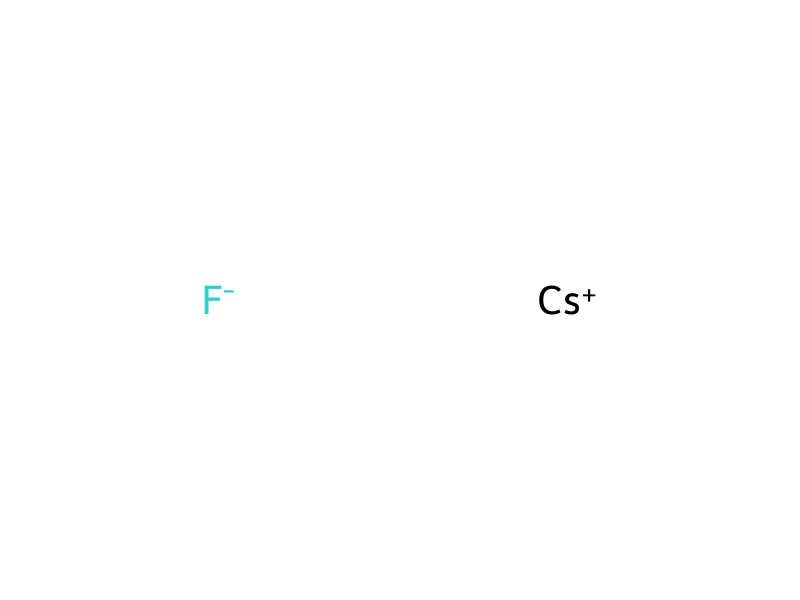
Cesium fluoride → HCID 57832852, compound
Reaction equation

[NH:1]1[C:10]2[C:5](=[CH:6][CH:7]=[C:8]([CH:11]3[CH2:16][CH2:15][N:14]([C:17]4[N:22]=[C:21]([CH3:23])[N:20]=[C:19](Cl)[C:18]=4[CH3:25])[CH2:13][CH2:12]3)[N:9]=2)[CH2:4][CH2:3][CH2:2]1.[NH2:26][CH2:27][C@@H:28]([C:40]([O:42][C:43]([CH3:46])([CH3:45])[CH3:44])=[O:41])[NH:29][C:30]([O:32][CH2:33][C:34]1[CH:39]=[CH:38][CH:37]=[CH:36][CH:35]=1)=[O:31].[F-].[Cs+]>COCCOC>[CH3:46][C:43]([O:42][C:40](=[O:41])[C@H:28]([CH2:27][NH:26][C:19]1[C:18]([CH3:25])=[C:17]([N:14]2[CH2:15][CH2:16][CH:11]([C:8]3[N:9]=[C:10]4[C:5]([CH2:4][CH2:3][CH2:2][NH:1]4)=[CH:6][CH:7]=3)[CH2:12][CH2:13]2)[N:22]=[C:21]([CH3:23])[N:20]=1)[NH:29][C:30]([O:32][CH2:33][C:34]1[CH:39]=[CH:38][CH:37]=[CH:36][CH:35]=1)=[O:31])([CH3:44])[CH3:45]Participants



Procedure
A mixture of 2.2 g (6.15 mmoles) of 6-[4-(1,2,3,4-tetrahydro-1,8-naphthyridin-7-yl)-1-piperidinyl]-2,5-dimethyl-4-chloro-pyrimidine and 2.17 g (7.38 mmoles) of (1,1-dimethylethyl) 3-amino-N-[(phenylmethoxy)carbonyl]alaninate (prepared according to J. Med. Chem. (2001), 44(8), 1158-1176), is heated under reflux for 24 hours in the presence of 1.31 g (8.61 mmoles) of caesium fluoride, 383 mg (0.615 mmoles) of (2,2′-bis(diphenylphosphino)-1,1′-binaphthyl and 281 mg (0.307 mmoles) of tris-dibenzylideneacetone)dipalladium(0), in 55 ml of 1,2-dimethoxyethane. The reaction mixture is then returned to ambient temperature, 281 mg (0.307 mmoles) of tris-dibenzylideneacetone)dipalladium(0) is added, then the reaction mixture is taken to reflux for another 24 hours. After cooling down the solution is concentrated to dryness under reduced pressure (2 kPa) then taken up in a mixture of water, ethyl acetate and a saturated solution of sodium bicarbonate. The organic phase is decanted and the aqueous phase is extracted with ethyl acetate. The combined organic phases are dried over magnesium sulphate and evaporated to dryness under reduced pressure (2 kPa). The residue is chromatographed on alumina with a gradient of isopropyl ether/ethyl acetate (50/50)-dichloromethane (50-50). The fractions containing the expected product are combined for a second purification on silicagel with a gradient of ethyl acetate-heptane-methanol 50-50-0 to 90-0-10. 550 mg (Yield=15%) of expected product is obtained.
Workup
- temperatureis heated
- customis then returned to ambient temperature
- temperatureto reflux for another 24 hours
- temperatureAfter cooling down the solution
- concentrationis concentrated to dryness under reduced pressure (2 kPa)
- additionthen taken up in a mixture of water, ethyl acetate
- customThe organic phase is decanted
- extractionthe aqueous phase is extracted with ethyl acetate
- dry with materialThe combined organic phases are dried over magnesium sulphate
- customevaporated to dryness under reduced pressure (2 kPa)
- customThe residue is chromatographed on alumina with a gradient of isopropyl ether/ethyl acetate (50/50)-dichloromethane (50-50)
- additionThe fractions containing the expected product
- customare combined for a second purification on silicagel with a gradient of ethyl acetate-heptane-methanol 50-50-0 to 90-0-10
Sources & evidence
- ORD record
- ord-ebdf953a242646a88798b2851b601914
- Source dataset
- uspto-grants-2010_07
- Patent number
- US07763621B2
Reaction notes
Loading…