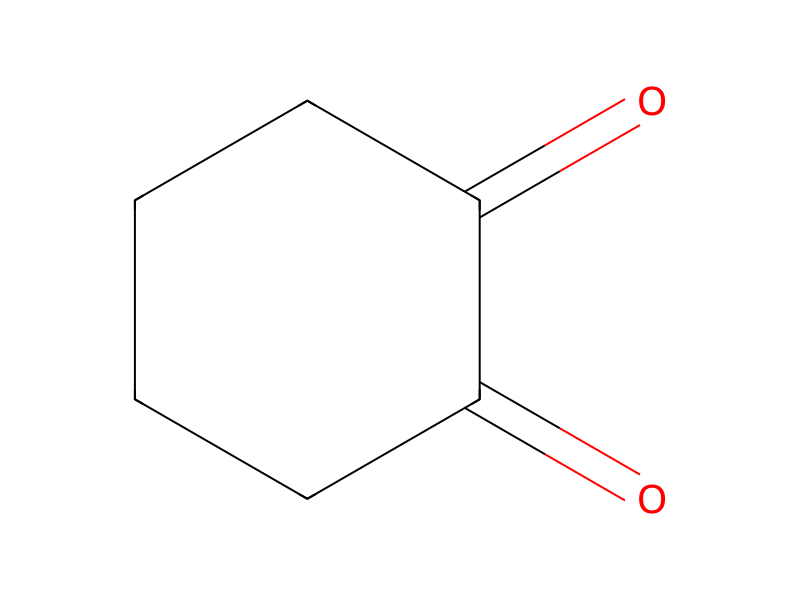
1,2-Cyclohexanedione → HCID 11954760, compound
Reaction equation

[CH2:1]1[C:9]2[C:4](=[CH:5][CH:6]=[CH:7][CH:8]=2)[C@@H:3]([NH2:10])[C@H:2]1[OH:11].[C:12]1(=[O:19])[CH2:17][CH2:16][CH2:15][CH2:14][C:13]1=O>>[CH2:15]1[CH2:14][C@:13]2([O:11][C@H:2]3[CH2:1][C:9]4[C:4]([C@H:3]3[NH:10]2)=[CH:5][CH:6]=[CH:7][CH:8]=4)[C@@:12]2([O:19][C@H:2]3[CH2:1][C:9]4[C:4]([C@H:3]3[NH:10]2)=[CH:5][CH:6]=[CH:7][CH:8]=4)[CH2:17][CH2:16]1Participants


Procedure
For example, employing (1R,2S)-cis-1-amino-2-indanol in the acid-promoted reaction with 1,2-cyclohexanedione, bisoxazolidine 1 was obtained in 90% yield and 99% de (FIG. 1B). It was shown that compound 1 was produced with excellent diastereoselectivity and exclusive formation of the (S,S)—N,O-diketal by crystallographic analysis: careful evaporation of a solution of 1 in chloroform gave the single crystal suitable for crystallographic analysis (CDCC602445). (Crystal structure data: C24H26N2O2, monoclinic, space group P21, a=16.9199(16) Å, b=5.5487(5) Å, c=23.585(2) Å, α=90.00°, β=108.5190(10)°, γ=90.00°, V=2099.6(3) Å3, Z=4, ρcalcd=1.367 g cm−3, T=173 K.) It was shown that the ligand possesses a C2-symmetric structure and an averaged separation of 2.35 Å between the nitrogen and oxygen atoms which facilitates bidentate binding to metal ions and organometallic compounds (FIG. 1C). It was envisioned that 1, as well as other bisoxazolidines, would be useful for a variety of asymmetric reactions.
Sources & evidence
- ORD record
- ord-2aee01e5dc5a4b7ab5540e08f5ef4f45
- Source dataset
- uspto-grants-2010_07
- Patent number
- US07763734B2
Reaction notes
Loading…