L-Glutamine → Glycylglutamine
Reaction equation

Cl.C[O:3][C:4](=O)[CH2:5][NH2:6].[NH2:8][C@H:9]([C:15]([OH:17])=[O:16])[CH2:10][CH2:11][C:12](=[O:14])[NH2:13]>O>[NH2:6][CH2:5][C:4]([NH:8][C@H:9]([C:15]([OH:17])=[O:16])[CH2:10][CH2:11][C:12](=[O:14])[NH2:13])=[O:3]Participants
4
Reactant 2
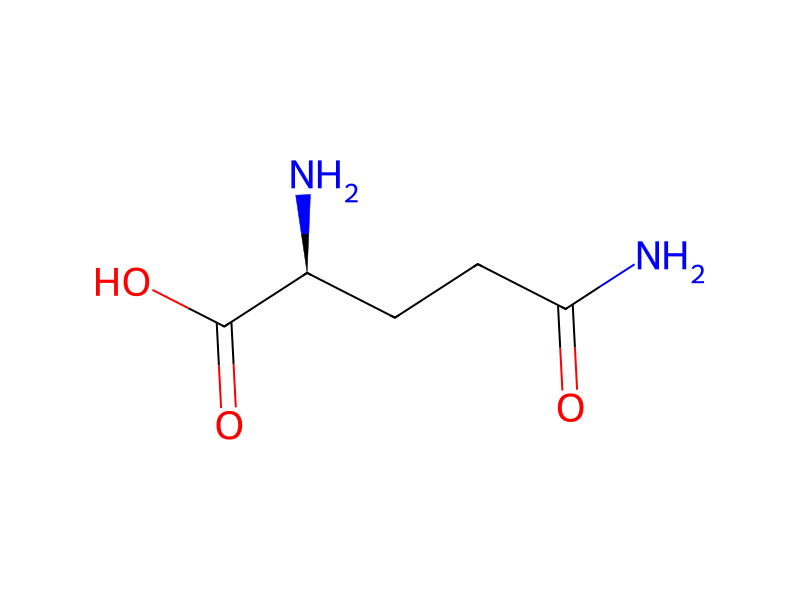

Product 1

Reagents, catalysts & solvents 1

Procedure
The same procedures used in Example 9 were repeated except that glycine methyl ester hydrochloride (hereunder referred to as Gly-OMe.HCl) was dissolved in L-Gln-TBP prepared by converting L-glutamine (L-Gln) into its ionic liquid form according to the same method used in Example 9 such that the concentration of the former was adjusted to 900 mmol/kg-L-Gln-TBP (the amount of water relative to the total mass of the reaction system: 14% by mass) and that the reaction time was changed from 20 hours to 23 hours to form the intended dipeptide, i.e., glycyl glutamine (Gly-Gln) and in this respect, the formation of such a desired dipeptide was confirmed according to the HPLC technique.
Workup
- customprepared
- wait14% by mass) and that the reaction time was changed from 20 hours to 23 hours
Sources & evidence
- ORD record
- ord-da602b6777574c6198324c4814361277
- Source dataset
- uspto-grants-2014_04
- Patent number
- US08691941B2
Reaction notes
Loading…