Boron trifluoride etherate → 5-Cyclopropyl-1-(phenylmethyl)-2-pyrrolidinone
Reaction equation

[CH:1]1([C:4]2(O)[N:8]([CH2:9][C:10]3[CH:15]=[CH:14][CH:13]=[CH:12][CH:11]=3)[C:7](=[O:16])[CH2:6][CH2:5]2)[CH2:3][CH2:2]1.C([SiH](CC)CC)C.B(F)(F)F.CCOCC>C(Cl)Cl>[CH:1]1([CH:4]2[N:8]([CH2:9][C:10]3[CH:11]=[CH:12][CH:13]=[CH:14][CH:15]=3)[C:7](=[O:16])[CH2:6][CH2:5]2)[CH2:2][CH2:3]1Participants
5
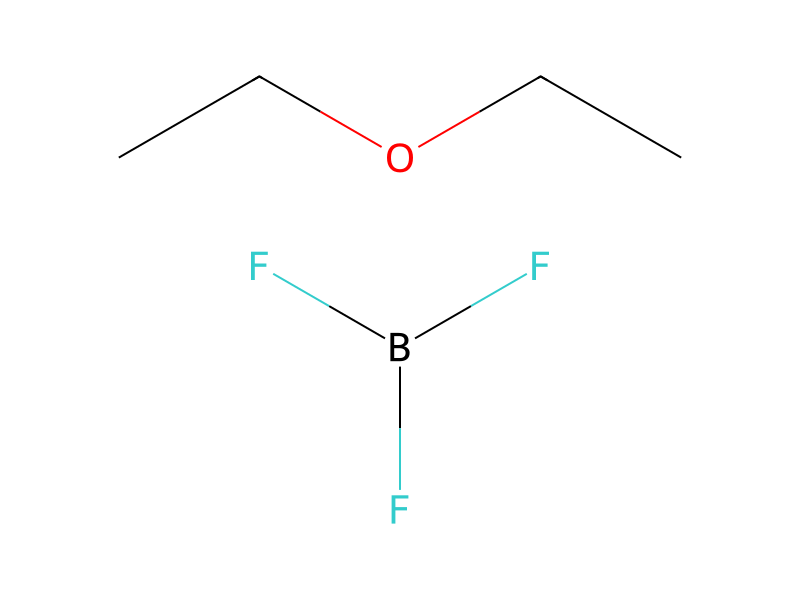




Conditions
- Temperature
- -78 °C
Procedure
To 5-cyclopropyl-5-hydroxy-1-(phenylmethyl)-2-pyrrolidinone (400 mg, 1.73 mmol) in CH2Cl2 (10 mL) at −78° C. was added a mixture of triethylsilane (2.76 mL, 17.3 mmol) and BF3.OEt2 (0.88 mL, 6.92 mmol) dropwise. The resulting reaction mixture was stirred for 2 hours at −78° C., then allowed to warm to room temperature and stirred overnight. The reaction was quenched by adding a saturated aqueous NaHCO3 solution, and the aqueous layer was extracted with CH2Cl2 (2×). The combined organic layers were dried (MgSO4), filtered and concentrated. Flash chromatography on SiO2 (gradient: 100% hexanes to 100% EtOAc) afforded the title compound (240 mg, 65%) as a colorless oil. LC-MS (ES) m/z=216 [M+H]+.
Workup
- customThe resulting reaction mixture
- temperatureto warm to room temperature
- stirringstirred overnight
- customThe reaction was quenched
- additionby adding a saturated aqueous NaHCO3 solution
- extractionthe aqueous layer was extracted with CH2Cl2 (2×)
- dry with materialThe combined organic layers were dried (MgSO4)
- filtrationfiltered
- concentrationconcentrated
Sources & evidence
- ORD record
- ord-2c38375a8326480389b378a94c88a8f4
- Source dataset
- uspto-grants-2014_04
- Patent number
- US08697685B2
Reaction notes
Loading…