Benzene, 1-bromo-3-nitro- → 3-Fluoro-3'-nitro-1,1'-biphenyl
Reaction equation

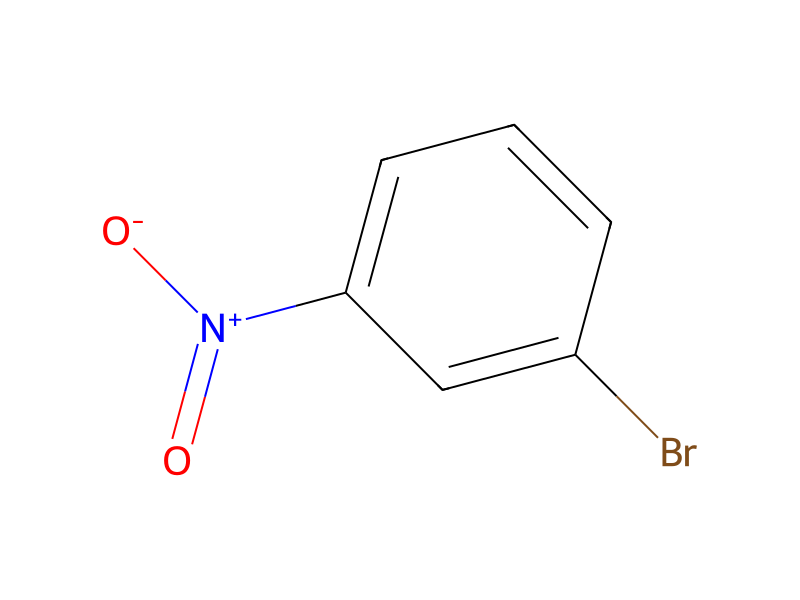
Br[C:2]1[CH:7]=[CH:6][CH:5]=[C:4]([N+:8]([O-:10])=[O:9])[CH:3]=1.[F:11][C:12]1[CH:13]=[C:14](B(O)O)[CH:15]=[CH:16][CH:17]=1.[O-]P([O-])([O-])=O.[K+].[K+].[K+].O1CCOCC1>C1C=CC([P]([Pd]([P](C2C=CC=CC=2)(C2C=CC=CC=2)C2C=CC=CC=2)([P](C2C=CC=CC=2)(C2C=CC=CC=2)C2C=CC=CC=2)[P](C2C=CC=CC=2)(C2C=CC=CC=2)C2C=CC=CC=2)(C2C=CC=CC=2)C2C=CC=CC=2)=CC=1.O>[F:11][C:12]1[CH:17]=[C:16]([C:2]2[CH:7]=[CH:6][CH:5]=[C:4]([N+:8]([O-:10])=[O:9])[CH:3]=2)[CH:15]=[CH:14][CH:13]=1Participants
Reactant 4



Product 1

Reagents, catalysts & solvents 2


Conditions
- Temperature
- 95 °C
Procedure
A 25 mL microwave vessel was charged with 1-bromo-3-nitrobenzene (XLVIII) (0.61 g, 3.0 mmol), 3-fluorophenylboronic acid (XLIX) (0.46 g, 3.3 mmol), potassium phosphate tribasic (0.95 g, 4.5 mmol), 1,4-dioxane (15.0 mL), and water (3.0 mL). Tetrakis(triphenylphosphine)palladium(0) (0.17 g, 0.15 mmol) was added, and the reaction was placed in a microwave reactor for 1 h at 95° C. An additional 3-fluorophenylboronic acid (0.20 g) and tetrakis(triphenylphosphine)palladium(0) (0.05 g) were added, and the reaction was heated for another 1 h at 95° C. in a microwave reactor. The organic solvent was separated from the water and concentrated to a residue. The residue was then purified by flash chromatography using a 25 g Thomson normal phase silica gel cartridge (100% hexanes→1:99 EtOAc:hexanes) to afford 3′-fluoro-3-nitrobiphenyl (L) (0.63 g, 2.91 mmol, 97% yield) as a white solid. 1H NMR (DMSO-d6) δ ppm 8.48 (t, J=2.0 Hz, 1H), 8.26-8.24 (m, 1H), 8.20-8.18 (m, 1H), 7.78 (t, J=8 Hz, 1H), 7.70-7.68 (m, 1H), 7.67-7.65 (m, 1H), 7.59-7.56 (m, 1H), 7.32-7.28 (m, 1H).
Workup
- customThe organic solvent was separated from the water
- concentrationconcentrated to a residue
- customThe residue was then purified by flash chromatography
Sources & evidence
- ORD record
- ord-3f6f6b9dfbaf4fd88249db1ef1ead840
- Source dataset
- uspto-grants-2014_04
- Patent number
- US08697887B2
Reaction notes
Loading…