Bromine → 5-bromo-1H-indazole-3-carboxylic Acid
Reaction equation

[NH:1]1[C:9]2[C:4](=[CH:5][CH:6]=[CH:7][CH:8]=2)[C:3]([C:10]([OH:12])=[O:11])=[N:2]1.[Br:13]Br>C(O)(=O)C>[Br:13][C:6]1[CH:5]=[C:4]2[C:9](=[CH:8][CH:7]=1)[NH:1][N:2]=[C:3]2[C:10]([OH:12])=[O:11]Participants
Reactant 2

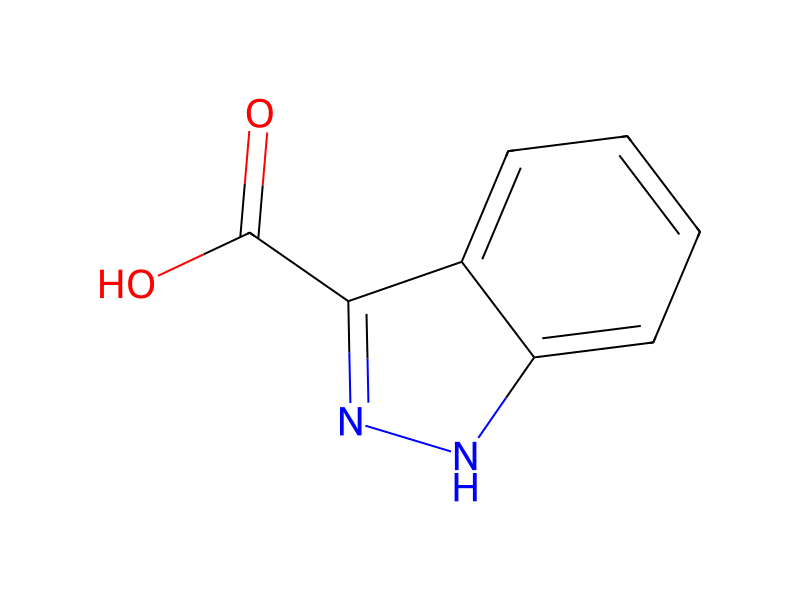
Product 1

Reagents, catalysts & solvents 1

Conditions
- Temperature
- 120 °C
Procedure
A suspension of indazole-3-carboxylic acid (CX) (1.0 g, 6.16 mmol) in glacial acetic acid (60 mL) was heated at 120° C. to get a clear solution. The solution was cooled to 90° C. A solution of bromine (0.633 mL, 12.33 mmol) in glacial acetic acid (2 mL) was added slowly to the solution while heating at 90° C. The solution was further heated 16 h at 90° C. The solution was cooled to room temperature, poured into ice water and further stirred at room temperature for 15 min The solids formed were filtered, washed with cold water and dried under vacuum at room temperature to get 5-bromo-1H-indazole-3-carboxylic acid (CXV) as a white solid (1.30 g, 5.39 mmol, 87.5% yield). 1H NMR (DMSO-d6) δ ppm 13.95 (s, 1H), 13.18 (br s, 1H), 8.21 (d, J=1.2 Hz, 1H), 7.65 (d, J=7.0 Hz, 1H), 7.56 (dd, J=7.0, 1.2 Hz, 1H); ESIMS found for C8H4BrN2O2 m/z 242.0 (M+H).
Workup
- customto get a clear solution
- temperatureThe solution was cooled to 90° C
- temperaturewhile heating at 90° C
- temperatureThe solution was cooled to room temperature
- customformed
- filtrationwere filtered
- washwashed with cold water
- customdried under vacuum at room temperature
Sources & evidence
- ORD record
- ord-edbfe5c552f5488b956bc2d2d8a01151
- Source dataset
- uspto-grants-2014_04
- Patent number
- US08697887B2
Reaction notes
Loading…