L-Serine → Acetoacetic Acid
Reaction equation

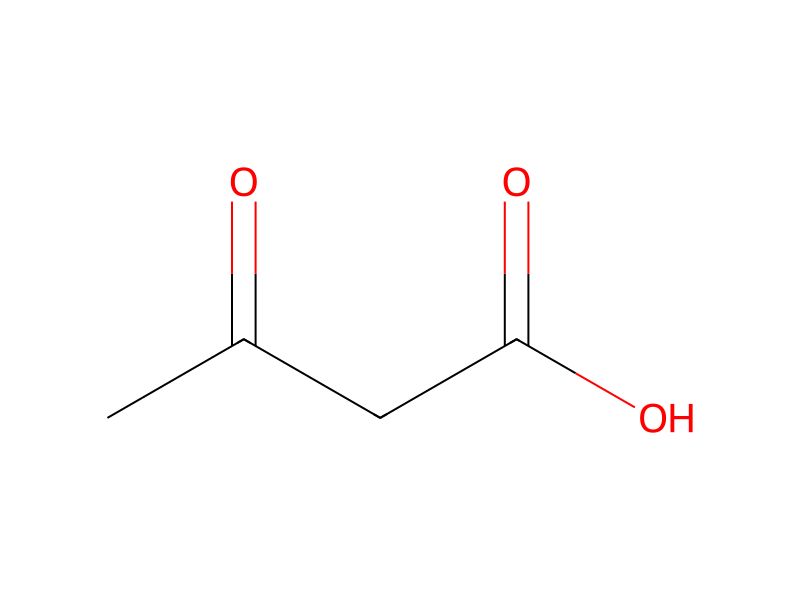
N[C@H:2]([C:5]([OH:7])=[O:6])[CH2:3][OH:4].[C:8]([OH:17])(=[O:16])[CH2:9]CCCC(C)C>N1C=CC=CC=1>[CH3:8][C:3]([CH2:2][C:5]([OH:7])=[O:6])=[O:4].[C:3]([O:17][C:8](=[O:16])[CH3:9])(=[O:4])[CH3:2]Participants
Reactant 2


Product 2

Reagents, catalysts & solvents 1

Procedure
BU-3862T exhibits strong absorptions at 3300 (hydroxy), 1720 (carbonyl), 1650 and 1530 cm-1 (amide) in the IR spectrum indicating a peptide structure for the antibiotic. The 13C-NMR spectrum demonstrated 20 carbons which were identified as two C--CH3, one =C--CH3, eight --CH2, three --CH, one >C<, one >C=CH2 and three C=O carbons. The molecular formula of BU-3862T was established as C20H34N2O6 based on the microanalysis, mass spectral data ((M+H)+ : m/z 399) and 13C-NMR spectral analysis. Thirty-four protons were observed in the 1H-NMR spectrum. The two doublet protons (δ7.03 and 6.48 ppm, in CDCl3) gradually disappeared by the addition of deutrium oxide were assigned to two --NH--CO groups. The broad two singlet protons (δ4.83 and 4.79) and the AB type doublet protons (δ3.35 and 3.12, J: 5.0 Hz) were assigned to exomethylene(--(CH3)C=CH2) and epoxide ##STR6## protons, respectively. The connectivities of these protons were determined by 1H-1H COSY experiments leading to the partial structures as shown below. Further connectivities of the partial structures were established by the 13C-1H COSY and 13C-1H long range COSY experiments. They were analyzed as shown below and thus the total structure of BU-3862T was determined. Further evidence for the structure was provided by its mass spectrum and degradation experiment. The EI-MS spectrum exhibited abundant fragment ions at m/z 127 (iso-octanoyl), 214 (iso-octanoyl-seryl) and 325 (iso-octanoyl-seryl-4,5-didehydroleucyl) supporting the structure. Upon acid hydrolysis, BU-3862T gave an amino acid and a fatty acid. The amino acid isolated was identified as L-serine by HPLC and the fatty acid as iso-octanoic acid by gas chromatography of its methyl ester. BU-3862T afforded the diacetate derivative upon treatment with acetic anhydride in pyridine. When hydrogenated over palladium carbon, BU-3862T afforded two reduction products, dihydro-BU-3862T and tetrahydro-BU-3862T, whose structures were determined based on their spectral data. The diacetate and the dihydro compound retained the biological activity but the tetrahydro derivative was devoid of the activity.
Sources & evidence
- ORD record
- ord-347d1555481443c38d25058607412287
- Source dataset
- uspto-grants-1992_03
- Patent number
- US05093248
Reaction notes
Loading…