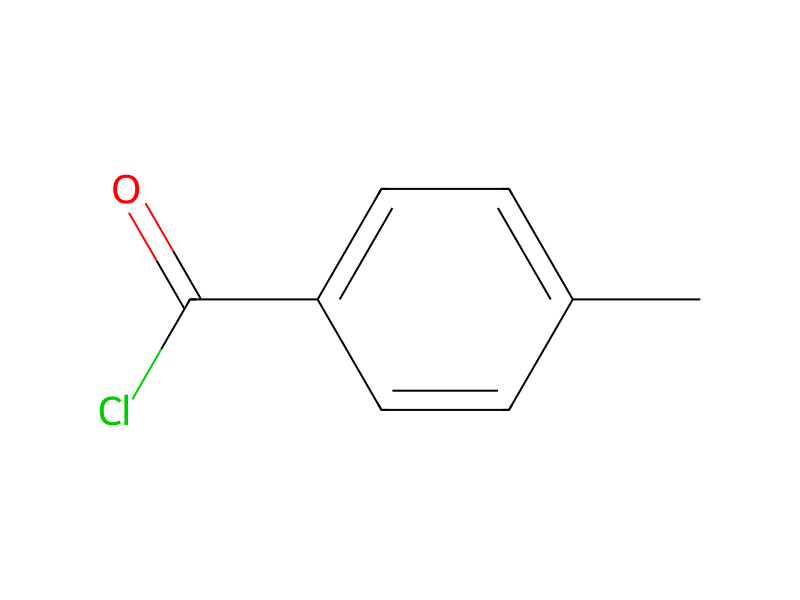
4-Methylbenzoyl Chloride → HCID 14366280, compound
Reaction equation

[CH3:1][C:2]1[CH:10]=[CH:9][C:5]([C:6](Cl)=[O:7])=[CH:4][CH:3]=1.C[O:12][P:13]1(=O)[C:18]2[CH:19]=[CH:20][CH:21]=[CH:22][C:17]=2[C:16]2[CH:23]=[CH:24][CH:25]=[CH:26][C:15]=2[O:14]1>>[CH3:1][C:2]1[CH:10]=[CH:9][C:5]([C:6]([P:13]2(=[O:12])[C:18]3[CH:19]=[CH:20][CH:21]=[CH:22][C:17]=3[C:16]3[CH:23]=[CH:24][CH:25]=[CH:26][C:15]=3[O:14]2)=[O:7])=[CH:4][CH:3]=1Participants
3


Conditions
- Temperature
- 110 °C
Procedure
30.8 g (0.2 mol) of 4-methylbenzoyl chloride were warmed to 80° C. under a nitrogen atmosphere. 46 g (0.2 mol) of 6-methoxy-(6H)-dibenz[c,e][1,2]-oxaphosphorin 6-oxide were added dropwise over the course of 1 hour while stirring. The temperature was then slowly increased to 110° C. When the reaction was complete, the residue slowly crystallized out at room temperature. 60 g (90% of theory) of the abovementioned compound, which, after recrystallization from toluene, had a melting point of 124 to 125% C. were obtained.
Workup
- customthe residue slowly crystallized out at room temperature
- custom60 g (90% of theory) of the abovementioned compound, which, after recrystallization from toluene
- customwere obtained
Sources & evidence
- ORD record
- ord-7b2a82711f1d48b7b02ce9434a66c84f
- Source dataset
- uspto-grants-1992_03
- Patent number
- US05096935
Reaction notes
Loading…