Participants
| Role | Name | HCID | Charge |
|---|
| Reactant | Carbon Dioxide | HCID 280 | — |
| Reactant | 9-Phenyl-9-(trifluoromethyl)-9H-xanthene-2,7-dicarboxylic acid | HCID 15180819 | — |
| Catalyst | Copper | HCID 23978 | — |
| Solvent | Quinoline | HCID 7047 | — |
| Product | HCID 15180802 | HCID 15180802 | 66% |
Reaction Steps
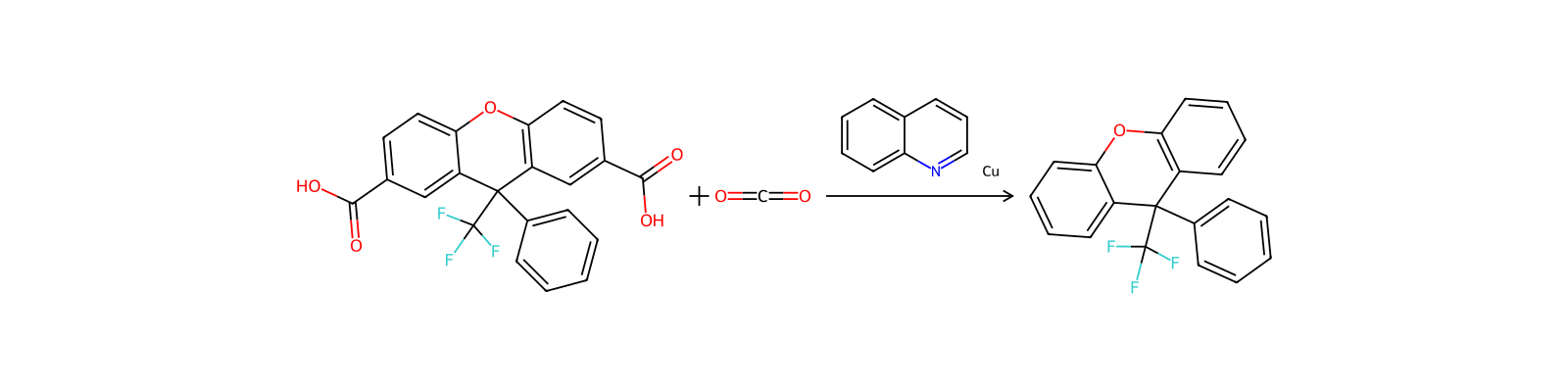
A 6 g sample of 9-phenyl-9-trifluoromethylxanthene-2,7-dicarboxylic acid (XX) was stirred and refluxed in 100 ml quinoline along with 11 g of copper powder, the emanating gas being measured by a wet-test meter. The theoretical amount of CO2 was evolved in two hours. The reaction mixture was cooled, filtered through a bed of Celite into 800 ml of water, acidified with 100 ml of concentrated hydrochloric acid, and left standing overnight. The supernantant liquid was decanted, and the residue was taken up in methylene chloride, and filtered through a bed of alumina. The solvent was stripped, the residue was stirred with methanol, and was filtered, yielding 3.1 g (66%) of a white solid. It was recrystallized from methanol; m.p. 89°-90°. The IR spectrum was sharp with no OH or CO bands. The NMR spectrum was confirmatory, with the following peaks: d 7.42; m 7.3-7.4; d 7.19, td 6.96, d 6.87 in 2:5:2:2:2 ratio. The compound was analyzed by mass spectrometry which showed the parent ion at 326, along with other peaks, the strongest being at 257 (parent minus trifluoromethyl), and also at 249 (parent minus phenyl), and 199 (parent minus phenyl and minus difluorocarbene). The mass spectrum confirmed the molecular formula as C20H13F3O.
Provenance & Evidence
| DOI | 10.6084/m9.figshare.5104873.v1 |
|---|
| Patent number | US05097000 |
|---|
| Source dataset | uspto-grants-1992_03 |
|---|
| ORD ID | ord-57c99afe7c0f4494a8ec791c8f8b0b6c |
|---|
| Source note | uspto-grants-1992_03 |
|---|