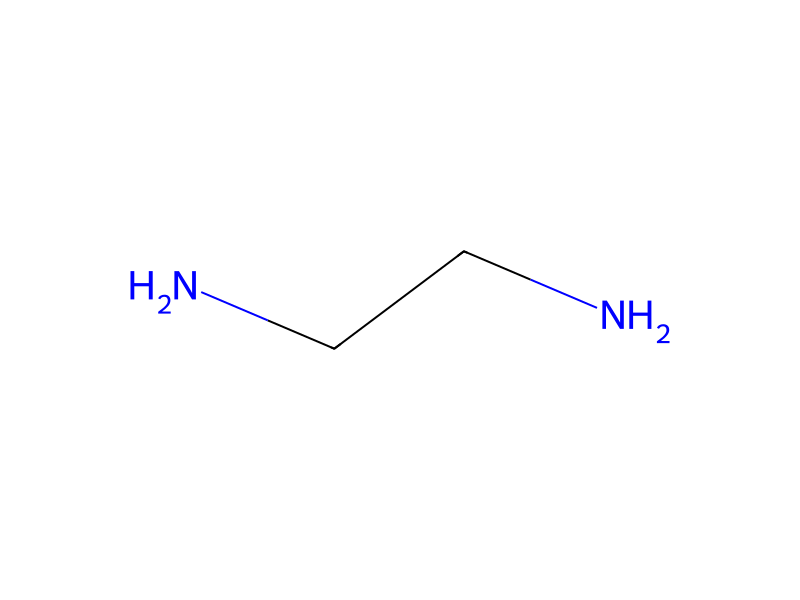
Ethylenediamine → HCID 54510412, compound
Reaction equation

[CH2:1]([NH2:4])[CH2:2][NH2:3].[Cl:5][C:6]1[CH:10]=[C:9](CBr)[O:8][N:7]=1.[C:13](#N)C>>[Cl:5][C:6]1[C:10]([CH2:13][NH:3][CH2:2][CH2:1][NH2:4])=[CH:9][O:8][N:7]=1Participants



Procedure
Ethylenediamine (10 g) was dissolved in acetonitrile (30 ml), and a solution of 3-chloro-5-bromomethylisoxazole (11.3 g) in acetonitrile (10 g) was added dropwise at 10° C.-15° C. The reaction mixture was then allowed to reach ambient temperature over 1 hour, decanted from a gummy precipitate and the acetonitrile removed by evaporation to give an orange oil, N-(3-chloroisoxazolylmethyl)ethylene diamine. The orange oil (8.7 g) was dissolved in ethanol (20 ml) and added to a suspension of 1-nitro-2,2-bis(methylthio)ethylene (8 g) in ethanol (50 ml) and the reaction mixture refluxed, with stirring, until evolution of methylmercaptan ceased (about 11/2 hours). Thin layer chromatography indicated two products. The solvent was removed in vacuo, and the residue thin-layer chromatographed to give the title compound as a colorless solid (5.9 g), m.p. after recrystallization was 173° C.
Workup
- customdecanted from a gummy precipitate
- customthe acetonitrile removed by evaporation
Sources & evidence
- ORD record
- ord-0eb54380fe0f4bcdab92b67f7e2c4f8d
- Source dataset
- uspto-grants-1994_11
- Patent number
- US05360906
Reaction notes
Loading…