Phenol → Phenol
Reaction equation

[C:1]1([OH:7])[CH:6]=[CH:5][CH:4]=[CH:3][CH:2]=1.[C:8](=[O:13])([O:11][CH3:12])[O:9][CH3:10]>CO>[C:8](=[O:13])([O:11][CH3:12])[O:9][CH3:10].[C:8](=[O:11])([O:7][C:1]1[CH:6]=[CH:5][CH:4]=[CH:3][CH:2]=1)[O:9][CH3:10].[C:8](=[O:13])([O:9][C:10]1[CH:5]=[CH:6][CH:1]=[CH:2][CH:3]=1)[O:7][C:1]1[CH:6]=[CH:5][CH:4]=[CH:3][CH:2]=1.[C:1]1([OH:7])[CH:6]=[CH:5][CH:4]=[CH:3][CH:2]=1Participants
Reactant 2

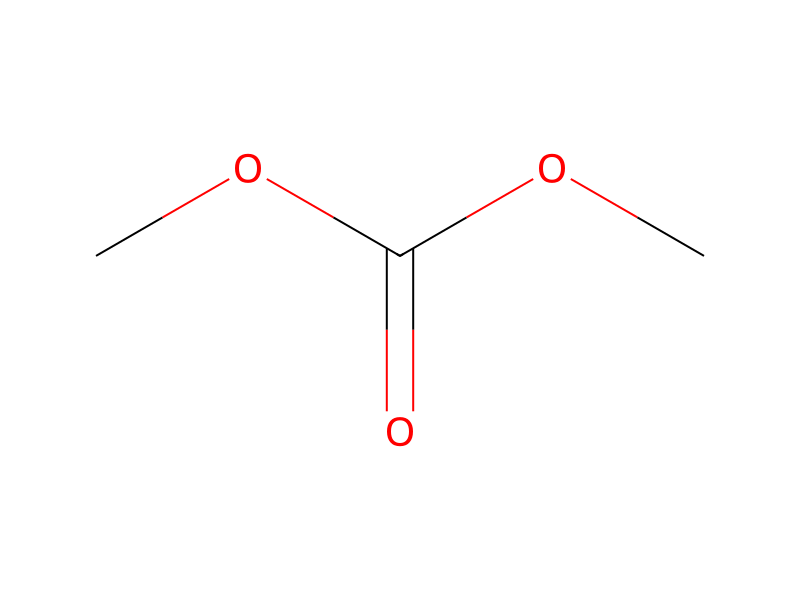
Product 4


Reagents, catalysts & solvents 1

Procedure
A liquid mixture of 150 g/h of phenol and 0.5 mol % of poly[oxy(butylhydroxystannylene)](--BuSn(OH)--O]n), preheated to 160° C., was continuously metered at the head into a column 185 cm in length and 28 mm in diameter isothermically thermostatted to 180° C. and filled with V4A stainless steel wire mesh rings (3×3 mm). 150 g/h of gaseous dimethyl carbonate were supplied in counter-current to this liquid stream, which dimethyl carbonate had been vaporised in a separate apparatus and fed into the column 35 cm above the column foot. At the top end of the column, which had a short enrichment part (15 cm adiabatic column equipped with a reflux divider), a mixture of methanol and dimethyl carbonate (head product) was continuously withdrawn, at the foot of the column, which had a short stripping part (35 cm oil-heated tube coil evaporator), 162 g/h of a mixture of 15.1% by weight of methyl phenyl carbonate, 1.6% by weight of diphenyl carbonate, 83.3% by weight of phenol and the catalyst (bottom product) were continuously withdrawn. The bottom product collected in a period of 4.5 h was subjected to intermediate storage and after completion of the first pass, was again fed to the head of the column at the same space-time loading and gaseous dimethyl carbonate was supplied in counter-current to this under conditions unchanged from the first pass. 173 g/h of a mixture of 26.3% by weight of methyl phenyl carbonate, 7.9% by weight of diphenyl carbonate and 65.8% by weight of phenol were now withdrawn at the column foot together with the catalyst (second pass). In a third pass of the product obtained from the second pass with a counter-current of dimethyl carbonate, 180 g/h of a bottom product of composition 28.6% by weight of methyl phenyl carbonate, 10.5% by weight of diphenyl carbonate and 60.8% by weight of phenol were obtained. This corresponds to a space-time yield for the methyl phenyl carbonate and diphenyl carbonate formation, based on three column passes, of 0.021 kg 1-1 h-1. When this mixture was then fed a fourth time in at the head of the column, without a counter-current of dimethyl carbonate, 196 g/h of a bottom product of composition 8.8% by weight of methyl phenyl carbonate, 34.7% by weight of diphenyl carbonate and 56.4% by weight of phenol were obtained, which gives a space-time yield for the formation of methyl phenyl carbonate and diphenyl carbonate, based on 4 column passes, of 0.020 kg 1-1 h-1.
Workup
- custompreheated to 160° C.
- customequipped with a reflux divider),
- customwas continuously withdrawn, at the foot of the column, which
- temperaturea short stripping part (35 cm oil-heated tube coil evaporator), 162 g/h of a mixture of 15.1% by weight of methyl phenyl carbonate, 1.6% by weight of diphenyl carbonate, 83.3% by weight of phenol
- customthe catalyst (bottom product) were continuously withdrawn
- customThe bottom product collected in a period of 4.5 h
- addition173 g/h of a mixture of 26.3% by weight of methyl phenyl carbonate, 7.9% by weight of diphenyl carbonate and 65.8% by weight of phenol
- customwere now withdrawn at the column foot together with the catalyst (second pass)
Sources & evidence
- ORD record
- ord-d977b880bfa94b6f9bc2219b33be408a
- Source dataset
- uspto-grants-1994_11
- Patent number
- US05362901
Reaction notes
Loading…