p-Bromochlorobenzene → HCID 12319462, compound
Reaction equation

Br[C:2]1[CH:7]=[CH:6][C:5]([Cl:8])=[CH:4][CH:3]=1.C([Li])CCC.[Br:14][C:15]1[CH:22]=[CH:21][CH:20]=[CH:19][C:16]=1[CH:17]=[O:18]>CCCCCC>[Br:14][C:15]1[CH:22]=[CH:21][CH:20]=[CH:19][C:16]=1[CH:17]([OH:18])[C:2]1[CH:7]=[CH:6][C:5]([Cl:8])=[CH:4][CH:3]=1Participants
Reactant 3
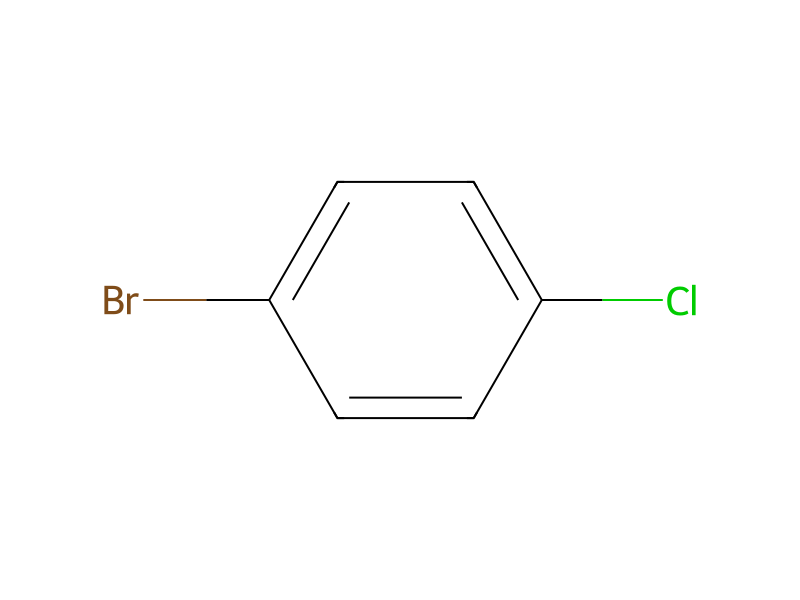


Product 1

Reagents, catalysts & solvents 1

Procedure
A solution of 23.0 g (120 mmole) of 4-bromochlorobenzene in 150 ml of dry tetrahydrofura: was cooled to -78° C. under nitrogen and 78 ml (120 mmole) of 1.55M n-butyllithium in hexane was added dropwise at a rate to maintain temperature below -60° C. After stirring an additional 15 minutes, 14.0 ml (120 mmole) of 2-bromo-benzaldehyde was added and the reaction was stirred for 15 minutes. The reaction was quenched at -78° C. with saturated aqueous ammonium chloride and allowed to warm to room temperature. The reaction solution was diluted with 300 ml of diethyl ether and washed with three 75 ml portions of 1.0M sodium bisulfite, followed by 50 ml of 1.0M sodium hydroxide, 100 ml of water, and 50 ml of saturated sodium chloride. After drying over magnesium sulfate, the solvent was removed to give 35.3 g (99%) of crude 2-bromo-α -(4-chlorophenyl)benzyl alcohol as a pale yellow oil.
Workup
- temperatureto maintain temperature below -60° C
- stirringthe reaction was stirred for 15 minutes
- customThe reaction was quenched at -78° C. with saturated aqueous ammonium chloride
- additionThe reaction solution was diluted with 300 ml of diethyl ether
- washwashed with three 75 ml portions of 1.0M sodium bisulfite
- dry with materialAfter drying over magnesium sulfate
- customthe solvent was removed
Sources & evidence
- ORD record
- ord-754a148e2ecc45f5a9118bcffc5f6755
- Source dataset
- uspto-grants-1994_11
- Patent number
- US05364843
Reaction notes
Loading…