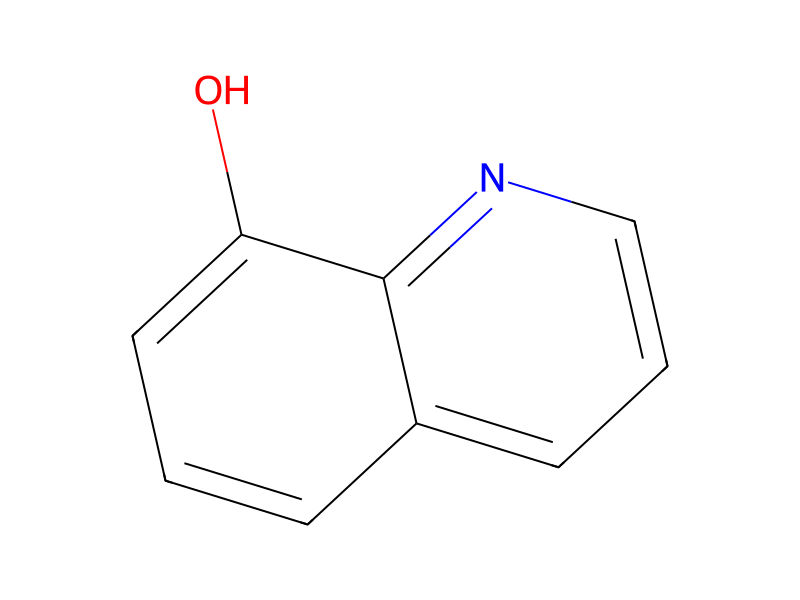
8-Hydroxyquinoline → HCID 57919098, compound
Reaction equation

Cl[C:2]1[C:3](=[O:15])[N:4](C2CCCCO2)[N:5]=[CH:6][C:7]=1Cl.[OH:16][C:17]1[CH:18]=[CH:19][CH:20]=[C:21]2[C:26]=1[N:25]=[CH:24][CH:23]=[CH:22]2.C[O:28][C:29](=[O:38])[CH:30](Br)[CH2:31][CH:32]1[CH2:36][CH2:35][CH2:34][CH2:33]1>>[CH:32]1([CH2:31][CH:30]([N:4]2[C:3](=[O:15])[CH:2]=[C:7]([O:16][C:17]3[CH:18]=[CH:19][CH:20]=[C:21]4[C:26]=3[N:25]=[CH:24][CH:23]=[CH:22]4)[CH:6]=[N:5]2)[C:29]([OH:28])=[O:38])[CH2:36][CH2:35][CH2:34][CH2:33]1Participants


Procedure
In an analogous manner to the stepwise sequence outlined in intermediate 19, starting from 4,5-dichloro-2-(tetrahydropyran-2-yl)-2H-pyridazin-3-one (Intermediate 20) and 8-hydroxyquinoline and alkylating with 2-bromo-3-cyclopentyl-propionic acid methyl ester (Intermediate 10) afforded 3-cyclopentyl-2-[6-oxo-4-(quinolin-8-yloxy)-6H-pyridazin-1-yl]-propionic acid (6.2 g, 64%) as a solid; LC-MS, [M+H+]=380.2; HPLC (0.05% trifluoroacetic acid in acetonitrile/water, 30%-90% acetonitrile, gradient, 1 mL/min, Venusil MP-C18, C18-15 cm×4.6 mm-5 μm), 254 nm, 97.9%, 214 nm, 96.7%. 1H-NMR (DMSO-d6, 300 MHz) δ 1.13-1.22 (m, 2H), 1.46-1.61 (m, 7H), 1.97-2.01 (m, 1H), 2.16-2.25 (m, 1H), 5.30-5.35 (dd, J=10.5, 3.9 Hz, 1H), 5.56-5.57 (d, J=2.4 Hz, 1H), 7.65-7.81 (m, 3H), 8.05-8.07 (d, J=7.8 Hz, 1H), 8.24-8.25 (d, J=2.7 Hz, 1H), 8.53-8.56 (d, J=8.1 Hz, 1H), 8.93-8.94 (d, J=3.0 Hz, 1H), 13.02 (s, br, 1H).
Sources & evidence
- ORD record
- ord-d3f92b19a33c4ea2be51260fcf84217f
- Source dataset
- uspto-grants-2012_09
- Patent number
- US08258134B2
Reaction notes
Loading…