Methyl formate → HCID 86640154, compound
Reaction equation

[CH3:1][O:2][C:3]1[CH:4]=[C:5]([CH2:9][CH2:10][CH2:11][CH2:12][CH2:13][CH2:14][C:15](OC)=[O:16])[CH:6]=[CH:7][CH:8]=1.[H-].C([Al+]CC(C)C)C(C)C.C(OC)=O.[Cl-].[NH4+].[Al]>ClCCl>[CH3:1][O:2][C:3]1[CH:4]=[C:5]([CH2:9][CH2:10][CH2:11][CH2:12][CH2:13][CH2:14][CH:15]=[O:16])[CH:6]=[CH:7][CH:8]=1Participants
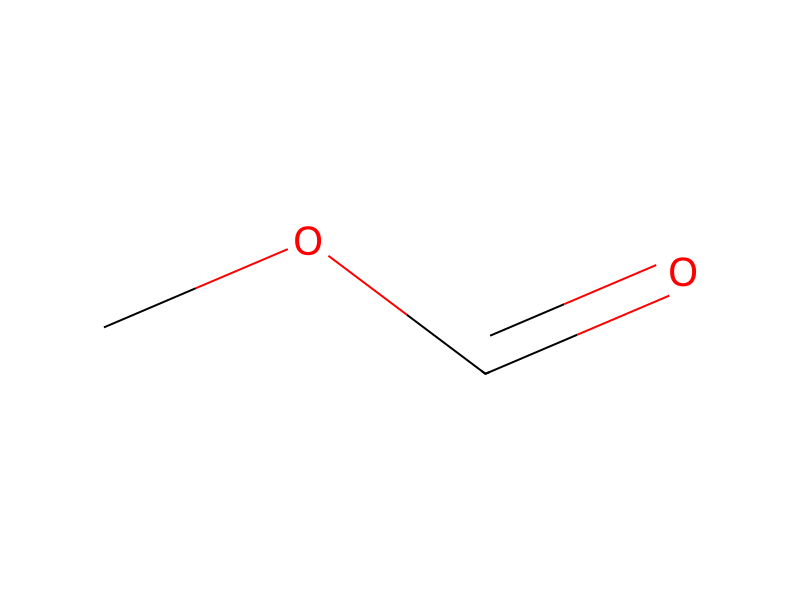






Conditions
- Temperature
- -78 °C
Procedure
Methyl 7-(3-methoxyphenyl)heptanoate (0.259 g, 1.04 mmol) was dissolved in dry dichloromethane (10 mL) under an atmosphere of argon and cooled to −78° C. A 1 M solution of diisobutylaluminum hydride (in hexanes) (1.19 mL, 1.19 mmol) was added and the reaction was allowed to proceed over 45 minutes. The reaction was quenched with methyl formate (0.0710 g, 1.04 mmol). The quenched reaction solution was allowed to warm to 0° C. and saturated ammonium chloride was added (2.8 mL) at which point aluminum salts precipitated from the solution. These salts were broken up with the addition of saturated sodium potassium tartrate (excess) and stirring for 18 hours at room temperature. The aqueous and organic layers were separated and the aqueous layer was washed twice with dichloromethane. The combined organic layers were washed with saturated sodium bicarbonate then brine. The organic layer was dried over sodium sulfate and the solvent was removed under reduced pressure. The aldehyde product was isolated as a clear oil (80%, 0.181 g) following flash column chromatography with silica (0-8% ethyl acetate:hexanes gradient mobile phase): 1H NMR (600 MHz, CDCl3) δ 9.75 (s, 1H), 7.19 (t, 1H), 6.73 (d, J=7.2 Hz, 1H), 6.72 (m, 2H), 3.80 (s, 3H), 2.58 (t, 2H), 2.42 (t, 2H), 1.63 (m, 4H), 1.36 (m, 4H); 13C NMR (150 MHz, CDCl3) δ 202.78, 159.56, 144.25, 129.17, 120.80, 114.17, 110.84, 55.09, 43.84, 35.88, 31.10, 28.99, 28.96, 21.97.
Workup
- customThe quenched reaction solution
- temperatureto warm to 0° C.
- customprecipitated from the solution
- additionThese salts were broken up with the addition of saturated sodium potassium tartrate (excess)
- customThe aqueous and organic layers were separated
- washthe aqueous layer was washed twice with dichloromethane
- washThe combined organic layers were washed with saturated sodium bicarbonate
- dry with materialThe organic layer was dried over sodium sulfate
- customthe solvent was removed under reduced pressure
Sources & evidence
- ORD record
- ord-c3293f3f2da540f4ba58ae961b000dcb
- Source dataset
- uspto-grants-2012_09
- Patent number
- US08268817B2
Reaction notes
Loading…