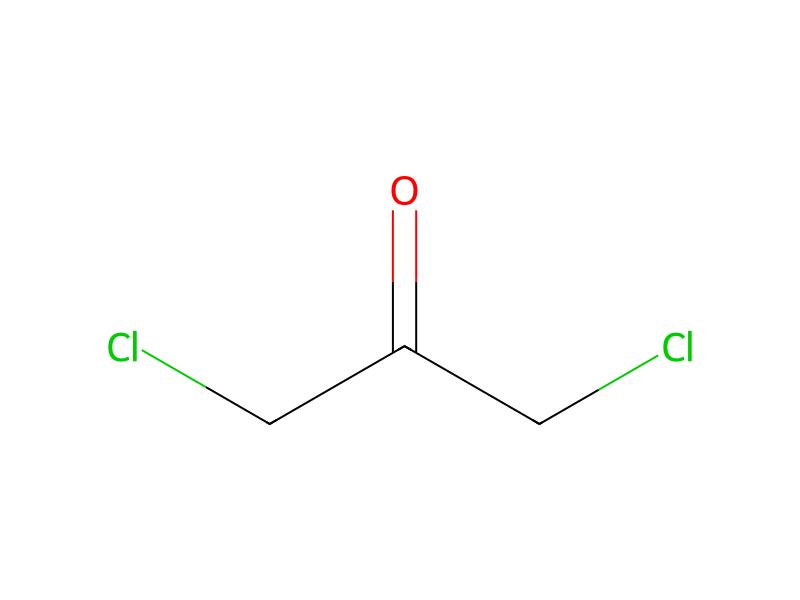
1,3-Dichloroacetone → 2-(Chloromethyl)-7-(2,4-dichlorophenyl)-5-(ethylsulphanyl)imidazo[1,2-c]pyrimidine
Reaction equation

[Cl:1][C:2]1[CH:7]=[C:6]([Cl:8])[CH:5]=[CH:4][C:3]=1[C:9]1[N:14]=[C:13]([S:15][CH2:16][CH3:17])[N:12]=[C:11]([NH2:18])[CH:10]=1.[Cl:19][CH2:20][C:21](=O)[CH2:22]Cl>C(O)C>[Cl:19][CH2:20][C:21]1[N:18]=[C:11]2[CH:10]=[C:9]([C:3]3[CH:4]=[CH:5][C:6]([Cl:8])=[CH:7][C:2]=3[Cl:1])[N:14]=[C:13]([S:15][CH2:16][CH3:17])[N:12]2[CH:22]=1Participants
4



Procedure
3 g (9.99 mmol) of 6-(2,4-dichlorophenyl)-2-(ethylsulphanyl)pyrimidine-4-amine (Example 3A) are added to a solution of 1.395 g (10.99 mmol) of 1,3-dichloropropan-2-one in 33 ml of dry ethanol, and the mixture is then heated under reflux conditions for 20 h. The solvent is substantially removed and the residue is purified by preparative HPLC. 1.5 g (37% of theory) of the product are obtained.
Workup
- temperaturethe mixture is then heated under reflux conditions for 20 h
- customThe solvent is substantially removed
- customthe residue is purified by preparative HPLC
- custom1.5 g (37% of theory) of the product are obtained
Sources & evidence
- ORD record
- ord-339366d093594f8590d43802dba8fb4c
- Source dataset
- uspto-grants-2012_09
- Patent number
- US08273752B2
Reaction notes
Loading…