2-Bromo-5-chloro-3-nitropyridine → 5-Chloro-3-nitropyridine-2-carbonitrile
Reaction equation

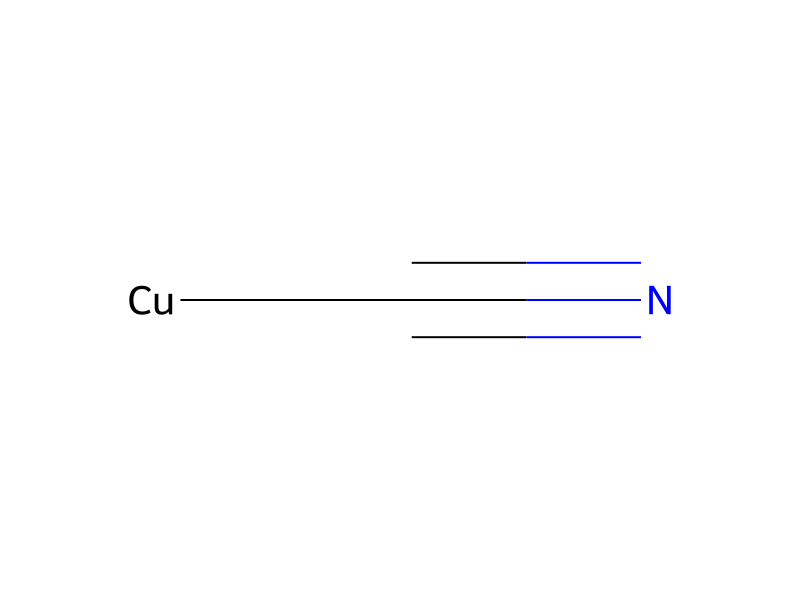
Br[C:2]1[C:7]([N+:8]([O-:10])=[O:9])=[CH:6][C:5]([Cl:11])=[CH:4][N:3]=1.[Cu][C:13]#[N:14]>CC(C)=O>[Cl:11][C:5]1[CH:6]=[C:7]([N+:8]([O-:10])=[O:9])[C:2]([C:13]#[N:14])=[N:3][CH:4]=1Participants
Reactant 2

Product 1

Reagents, catalysts & solvents 1

Procedure
2-Bromo-5-chloro-3-nitropyridine (103) (6.0 g, 25 mmol) was mixed with copper (I) cyanide (4.6 g, 51 mmol) in a 100 mL round-bottom flask having a condensor loosely plugged with cotton was attached. The flask was slowly heated in an oil bath. When the temperature reaches approximately 150° C. (takes 2 h), the reaction mass begins to turn black. When the reaction mass turned completely black, the pressure was reduced to approximately 1 mm Hg by vacuum and the oil bath removed after 30 sec. (If the reaction goes too long, a vigorous reaction ensues, leaving little recoverable product.) The mixture was cooled to room temperature, and the sublimed solid (on the cotton) and reaction mass were treated with hot acetone (100 mL). The resulting mixture was gravity filtered, and the mother liquor rota-evaporated to dryness to yield the crude title compound as a dark brown solid. This solid can be purified by column chromatography using 4:1 hexane-EtOAc (Rf =0.13). Purified 104 was obtained in 60% yield overall, mp 93°-5° C. (Lit., 75° C., Berrie, et al., J. Amer. Chem. Soc.:2042 (1952)); 1H NMR (CDCl3): δ8.62 (d, J=1.5 Hz, 1H), 8.95 (d, J=1.5 Hz, 1H).
Workup
- temperatureThe flask was slowly heated in an oil bath
- customreaches approximately 150° C.
- custom(takes 2 h)
- customthe oil bath removed after 30 sec
- customa vigorous reaction
- customleaving little recoverable product
- customthe sublimed solid (on the cotton) and reaction mass
- filtrationfiltered
- customthe mother liquor rota-evaporated to dryness
Sources & evidence
- ORD record
- ord-0a1273534330464c8b8d808ca98737e5
- Source dataset
- uspto-grants-1998_09
- Patent number
- US05801183
Reaction notes
Loading…