Reuterin → 1,3-Propanediol
Reaction equation

[OH:1][CH2:2][CH2:3][CH:4]=[O:5].[H][H]>[Ni]>[CH2:4]([OH:5])[CH2:3][CH2:2][OH:1].[OH:5][CH2:4][CH2:3][CH:2]=[O:1]Participants
Reactant 2


Product 2
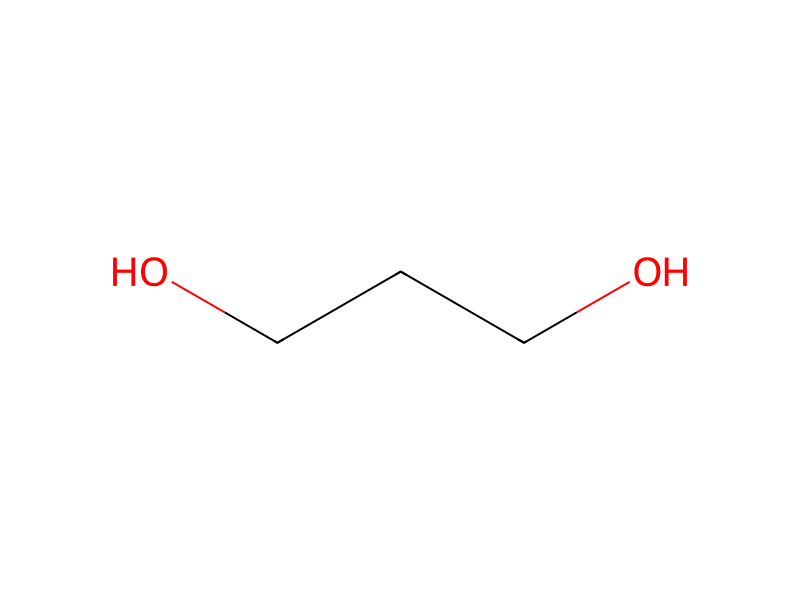
Reagents, catalysts & solvents 1

Procedure
There is produced a solution containing 8.1 percent by weight of 3-hydroxypropanal and 1.3 percent by weight of dimerized 3-hydroxypropanal both obtained as the result of the above hydration reaction. A known raney nickel catalyst is added to the resulting solution to hydrogenate 3-hydroxypropanal and dimerized 3-hydroxypropanal. Reaction conditions are: a hydrogen pressure of 100 kg/cm2, a reaction temperature of 60° C., and reaction time of six hours. When the reaction ends, the resulting solution is analyzed and it is acknowledged that there is produced 1,3-propanediol in an amount equal to a total of 3-hydroxypropanal and dimerized 3-hydroxypropanal. In other words, 1,3-propanediol is quantitatively produced. This indicates that dimerized 3-hydroxypropanal is converted into 1,3-propanediol by a known hydrogenation process.
Workup
- customThere is produced a solution
- customboth obtained as the
- customresult of the above hydration reaction
- customReaction conditions
Sources & evidence
- ORD record
- ord-8926163e2626468d85b4e219bf4f940d
- Source dataset
- uspto-grants-1998_09
- Patent number
- US05811591
Reaction notes
Loading…