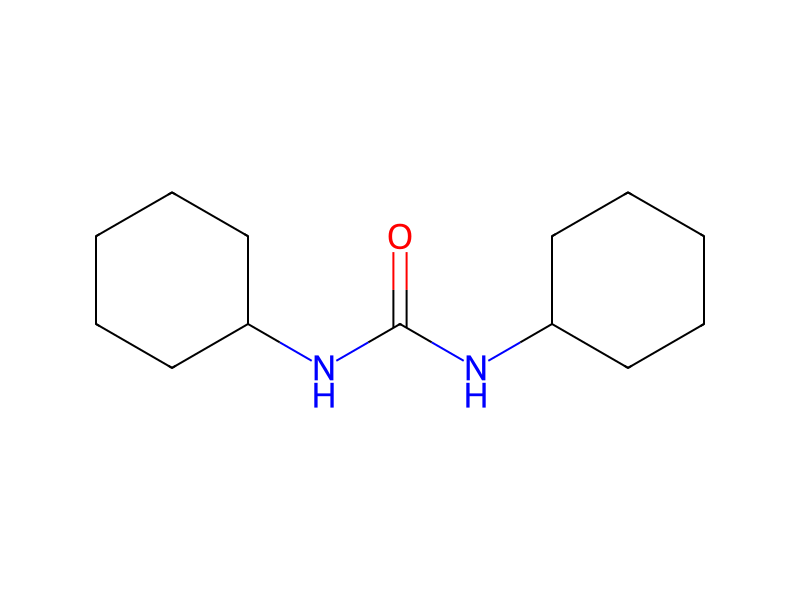
Formic Acid → N,N'-Dicyclohexylurea
Reaction equation

C(O)=[O:2].[CH:4]1([N:10]=[C:11]=[N:12][CH:13]2[CH2:18][CH2:17][CH2:16][CH2:15][CH2:14]2)[CH2:9][CH2:8][CH2:7][CH2:6][CH2:5]1>C(Cl)(Cl)Cl.N1C=CC=CC=1>[C:11]([NH:10][CH:4]1[CH2:5][CH2:6][CH2:7][CH2:8][CH2:9]1)([NH:12][CH:13]1[CH2:18][CH2:17][CH2:16][CH2:15][CH2:14]1)=[O:2]Participants
Reactant 2


Product 1
Reagents, catalysts & solvents 2


Procedure
To a solution of formic acid (0.504 mL, 13.36 mmol) in chloroform (37 mL) was added dropwise dicyclohexylcarbodiimide (DCC) (2.75 g, 13.36 mmol) in chloroform (37 mL) at 0° C. After 5 min., the above solution was added to the compound 9 (2.5 g, 6.68 mmol) in pyridine (20 mL). The mixture was then stirred for 1 hours at room temperature. Evaporation of solvent was followed by addition of ether gave dicyclohexylurea which was removed via filtration and the solid was washed with ether. The combined filtrate was concentrated and purified by flash column chromatography to give the compound 11, R1 =C5H11 (EM-401) (2.5 g, 93%) The NMR spectroscopy analysis gave a (4:1) mixture of two conformers, M.P. 149°-151° C.; 1H NMR (CDCl3): δ 0.67 (s ,3H), 0.86 (s, 3H), 0.82-1.19 (m, 6H), 1.21-1.42 (m, 11H), 1.56-1.57 (m, 2H), 1.69-1.91 (m, 4H), 1.92-1.97 (m, 3H), 2.38-2.43 (m, 2H), 2.89 (s, 3H ), 3.0 (dd, 1H, J=3.2, 12.4 Hz), 3.21-3.28 (m, 3H), 8.14 (s, 0.8H), 8.2 (s, 0.2H); 13C NMR (CDCl3):δ 170 .56, 164.8, 162.97, 68.54, 65.58, 61.98, 51.93, 51.66, 51.24, 46.69, 44.28, 37.24, 36.8, 36.37, 34.07, 32.83, 32.12, 29.64, 29.13, 29.04, 28.8, 28.19, 25.15, 24.33, 23.22, 22.84, 22.36, 20.51, 13.94, 12.75, 12.32;HRMS: calcd for C25H42O2N2, 402.3245, found 402.3242.
Workup
- customEvaporation of solvent
- additionwas followed by addition of ether
Sources & evidence
- ORD record
- ord-ad61ca636f194d22b3f0807222019402
- Source dataset
- uspto-grants-1996_02
- Patent number
- US05494914
Reaction notes
Loading…