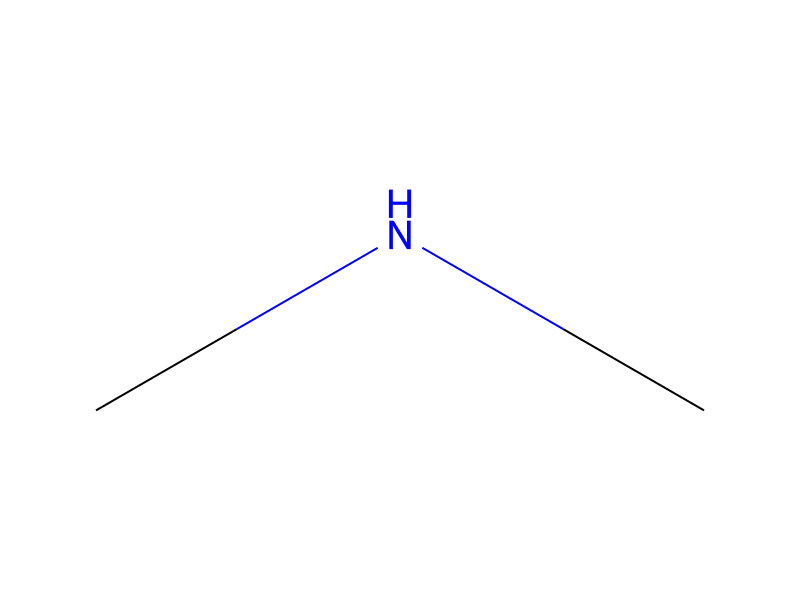
Dimethylamine → Dimethylamine
Reaction equation

[N:1]1[CH:6]=[CH:5][CH:4]=[C:3]([CH:7]=[C:8]2[CH2:13][CH2:12][CH2:11][CH2:10][C:9]2=[O:14])[CH:2]=1.[CH3:15][NH:16][CH3:17]>>[CH3:15][N:16]([CH:7]([C:3]1[CH:2]=[N:1][CH:6]=[CH:5][CH:4]=1)[CH:8]1[CH2:13][CH2:12][CH2:11][CH2:10][C:9]1=[O:14])[CH3:17].[CH3:2][NH:1][CH3:6]Participants


Procedure
Treatment of II with the appropriate secondary amine, such as dimethylamine, N-methyl-ethylamine, or N-methyl-benzylamine, at moderate temperatures, conveniently room temperature, either with or without an inert solvent, for a period of time sufficient to allow a practical amount of conversion to occur, conveniently about 24 to about 48 hours, gives the corresponding 2-[(disubstituted amino)(3-pyridyl)methyl]cyclohexanone (III). The product may, if desired, be used for further synthesis without treatment other than removal of unreacted amine. For example, if 2-(3-pyridylmethylene)cyclohexanone is treated with dimethylamine at room temperature, conveniently in a pressure bottle, as the boiling point of dimethylamine is less than room temperature, for about 36 hours, 2-[(dimethylamino)(3-pyridyl)methyl]cyclohexanone (IIIa) is obtained from which the more volatile dimethylamine may be removed by evaporation in vacuo. Treatment of III with a carbonyl reducing agent such as THF-borane in an inert solvent, conveniently tetrahydrofuran (THF), initially at reduced temperature, conveniently about 0° to about 10° C., then at moderate temperature, conveniently ambient temperature, followed by work-up by standard techniques, conveniently decomposing the reaction complex with water initially at reduced temperature, typically at about 5° C., then at ambient temperature, followed by evaporation of the THF followed by alternate partitioning between aqueous base and diethyl ether and aqueous acid and diethyl ether, gives I. Separation of I, if desired, may be accomplished by standard techniques. Chromatography on alumina is a convenient technique. For example, IIIa may be treated, in tetrahydrofuran solution, by adding it dropwise to a solution of THF-borane, cooled to about 0° to about 10° C. and maintained at this temperature during the addition period. The reaction mixture may be permitted to warm to ambient temperature, then recooled and treated with an excess of water. After standing for some time at room temperature, conveniently about 60 hours, the tetrahydrofuran may be evaporated and the residue partitioned between diethyl ether and dilute aqueous sodium hydroxide. The organic phase may then be treated with dilute aqueous mineral acid. The aqueous layer may then be made base and partitioned with diethyl ether. The organic phase may then be dried and the solvent evaporated. The residue so obtained may then be chromatographed on grade III alumina to give 2-[(dimethylamino) (3-pyridyl)methyl]cyclohexanol (Ia).
Sources & evidence
- ORD record
- ord-f9953ca5bbcd4af59fd03dd09cf5174e
- Source dataset
- uspto-grants-1977_05
- Patent number
- US04021560
Reaction notes
Loading…