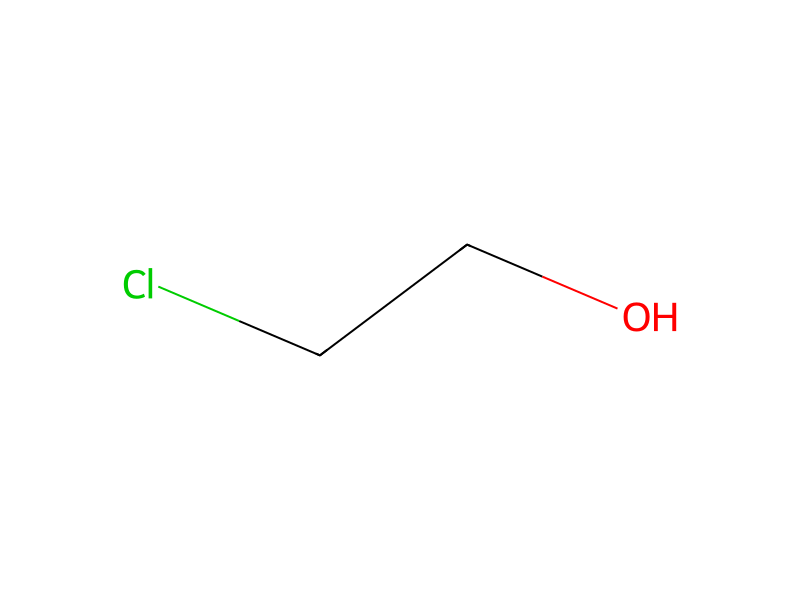
2-Chloroethanol → 5-(beta-Hydroxyethyl-mercapto)-salicylic acid
Reaction equation

[SH:1][C:2]1[CH:10]=[C:6]([C:7]([OH:9])=[O:8])[C:5]([OH:11])=[CH:4][CH:3]=1.Cl[CH2:13][CH2:14][OH:15]>[OH-].[Na+]>[OH:15][CH2:14][CH2:13][S:1][C:2]1[CH:10]=[C:6]([C:7]([OH:9])=[O:8])[C:5]([OH:11])=[CH:4][CH:3]=1Participants
Reactant 2

Product 1

Reagents, catalysts & solvents 1

Procedure
85 g (0.5 mole) of 5-mercaptosalicylic acid were reacted at room temperature with 41.5 g (0.5 mole) β-chloroethanol in 500 ml sodium hydroxide solution of 20% strength, whereby 90 g 5-(β-hydroxyethyl-mercapto)-salicylic acid melting at 136° C. were obtained (yield 71% of theory). 120 g (0.55 mole) of the aryl-alkyl sulfide obtained were oxidized in 200 ml glacial acetic acid at 65° C. with 215 ml 30% hydrogen peroxide whereby 103 g 5-(β-hydroxyethyl-sulfonyl)-salicyclic acid (yield 77% of theory) melting at 175° C. were obtained. 71.5 g (0.29 mole) of the 5-(β-hydroxyethylsulfonyl)-salicylic acid were then reacted for 5 hours at 70° C. with a mixture of 20 ml (0.29 mole) chlorosulfonic acid and 150 ml anhydrous dioxane, in which reaction hydrogen chloride was split off. The dissolved 5-(β-hydroxysulfonyl-oxy-ethylsulfonyl)-salicylic acid was reacted with a suspension of 91 g (0.5 mole) barium carbonate in 250 ml water (generation of CO2). After filtration, the limpid solution was concentrated by evaporation at 40° C. 120 g of the barium salt of 5-(-hydroxysulfonyloxyethyl-sulfonyl)-salicylic acid (R'--SO2 --CH2CH2 --OSO3Ba/2, R' = barium salicylate) melting at 266° C. remained behind (yield 90% of theory).
Sources & evidence
- ORD record
- ord-7c872d9b162b4e77a3aa21591c1c3b97
- Source dataset
- uspto-grants-1977_05
- Patent number
- US04022964
Reaction notes
Loading…