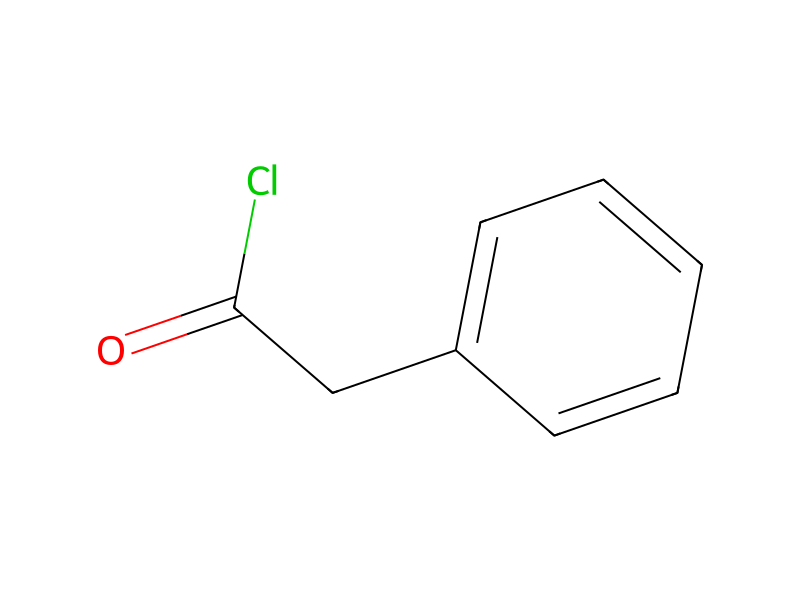
Phenylacetyl chloride → Ethyl 2-(2-benzyl-5-benzoxazolyl)propionate
Reaction equation

[C:1]1([CH2:7][C:8](Cl)=[O:9])[CH:6]=[CH:5][CH:4]=[CH:3][CH:2]=1.[NH2:11][C:12]1[CH:13]=[C:14]([CH:19]([CH3:25])[C:20]([O:22][CH2:23][CH3:24])=[O:21])[CH:15]=[CH:16][C:17]=1O>N1C=CC=CC=1>[CH2:7]([C:8]1[O:9][C:17]2[CH:16]=[CH:15][C:14]([CH:19]([CH3:25])[C:20]([O:22][CH2:23][CH3:24])=[O:21])=[CH:13][C:12]=2[N:11]=1)[C:1]1[CH:6]=[CH:5][CH:4]=[CH:3][CH:2]=1Participants
Reactant 2

Product 1

Reagents, catalysts & solvents 1

Conditions
- Temperature
- 100 °C
Procedure
Phenyl acetyl chloride (2.2 ml.) was added to a stirred solution of ethyl 2-(3-amino-4-hydroxyphenyl)propionate (3.15g.) in anhydrous pyridine (50 ml.) and the solution was heated at 100° C. for two hours. Excess pyridine was removed by distillation and the residue heated until the temperature of the distillate immediately above the reaction mixture was 200° C. The resultant dark brown gum was dissolved in ether (75 ml.) and then washed with water (3 × 50 ml.) The ether solution was extracted with 1N sodium hydroxide (50 ml.), washed with water (2 × 50 ml.) and evaporated to give ethyl 2-(2-benzyl-5-benzoxazolyl)propionate as a light brown mobile gum, which was shown to be pure by thin layer chromatography. Similarly the following esters were prepared and characterised:
Workup
- customExcess pyridine was removed by distillation
- temperaturethe residue heated until the temperature of the distillate immediately above the reaction mixture
- customwas 200° C
- dissolutionThe resultant dark brown gum was dissolved in ether (75 ml.)
- washwashed with water (3 × 50 ml.) The ether solution
- extractionwas extracted with 1N sodium hydroxide (50 ml.)
- washwashed with water (2 × 50 ml.)
- customevaporated
Sources & evidence
- ORD record
- ord-0480daa780d845a580b8da646282c951
- Source dataset
- uspto-grants-1977_05
- Patent number
- US04025637
Reaction notes
Loading…