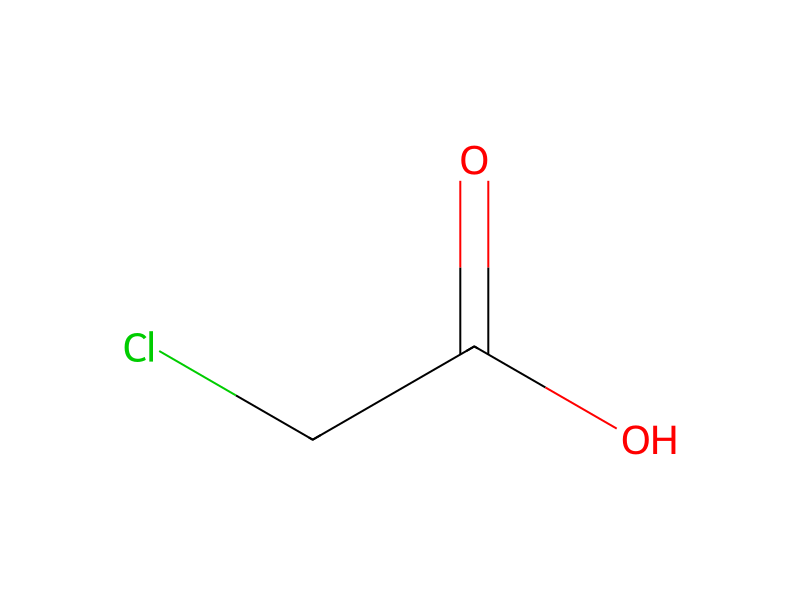
Chloroacetic Acid → 2-(2-Acetyl-4-bromophenoxy)acetic acid
Reaction equation

[Br:1][C:2]1[CH:3]=[CH:4][C:5]([OH:11])=[C:6]([C:8](=[O:10])[CH3:9])[CH:7]=1.Cl[CH2:13][C:14]([OH:16])=[O:15].[OH-].[Na+]>O>[C:8]([C:6]1[CH:7]=[C:2]([Br:1])[CH:3]=[CH:4][C:5]=1[O:11][CH2:13][C:14]([OH:16])=[O:15])(=[O:10])[CH3:9]Participants
5
Reactant 3


Product 1

Reagents, catalysts & solvents 1

Procedure
A solution of 1-(5-bromo-2-hydroxyphenyl)ethanone (9.53 mmol) in water (70 mL) was treated with chloroacetic acid (11.64 mmol) and a solution of NaOH (21.25 mmol) in water (20 mL). The resulting yellow suspension was flushed with N2 and stirred at reflux overnight. Analysis by LCMS indicated the consumption of starting material and desired product formation. The reaction was cooled to room temperature and then acidified to pH˜3 with 1N aq HCl. The mixture was then cooled to 0° C. resulting in precipitate formation. A grey sticky solid was filtered and used without further purification. MS(ES)+ m/e 273/275 [M+H]+ (bromide isotope pattern).
Workup
- customThe resulting yellow suspension was flushed with N2
- temperatureat reflux overnight
- customthe consumption of starting material and desired product formation
- temperatureThe mixture was then cooled to 0° C.
- customresulting in precipitate formation
- filtrationA grey sticky solid was filtered
- customused without further purification
Sources & evidence
- ORD record
- ord-6e68f8cc05f449349ec3f1bbe305851f
- Source dataset
- uspto-grants-2014_08
- Patent number
- US08802864B2
Reaction notes
Loading…