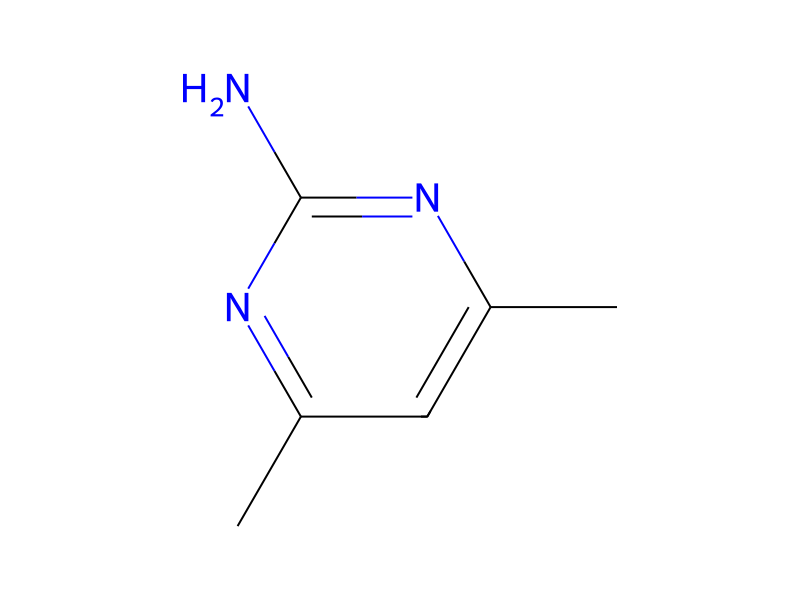
2-Amino-4,6-dimethyl pyrimidine → HCID 20432144, compound
Reaction equation

[Cl:1][CH:2]1[CH2:8][CH2:7][CH2:6][CH2:5][CH2:4][CH:3]1[S:9]([N:12]=[C:13]=[O:14])(=[O:11])=[O:10].[NH2:15][C:16]1[N:21]=[C:20]([CH3:22])[CH:19]=[C:18]([CH3:23])[N:17]=1>ClCCl>[CH3:23][C:18]1[CH:19]=[C:20]([CH3:22])[N:21]=[C:16]([NH:15][C:13]([NH:12][S:9]([CH:3]2[CH2:4][CH2:5][CH2:6][CH2:7][CH2:8][CH:2]2[Cl:1])(=[O:11])=[O:10])=[O:14])[N:17]=1Participants
4
Reactant 2

Product 1

Reagents, catalysts & solvents 1

Conditions
- Temperature
- 0 °C
Procedure
14.3 g (0.06 mole) of 2-chlorocycloheptylsulfonyl isocyanate in 100. ml of dichloromethane were initially introduced and 7.4 g (0.06 mole) of 2-amino-4,6-dimethylpyrimidine were added in portions at 0° C. The mixture was stirred initially at 0° C. for 2 hours and then at room temperature for 18 hours. The organic phase was then extracted with 3×40 ml of 2N H2SO4, washed to neutrality and the organic layer was dried over Na2SO4. Then 50 ml of n-hexane was added and the solvent was distilled off in vacuo. 13.3 g (61% of theory) of N-[(4,6-dimethylpyrimidin-2-yl)aminocarbonyl]-2-chlorocycloheptylsulfonamide were obtained (viscous oil).
Workup
- waitat room temperature for 18 hours
- extractionThe organic phase was then extracted with 3×40 ml of 2N H2SO4
- washwashed to neutrality
- dry with materialthe organic layer was dried over Na2SO4
- additionThen 50 ml of n-hexane was added
- distillationthe solvent was distilled off in vacuo
Sources & evidence
- ORD record
- ord-dd363f508f2e42b2ab23065059e0e4e6
- Source dataset
- uspto-grants-1985_01
- Patent number
- US04492598
Reaction notes
Loading…