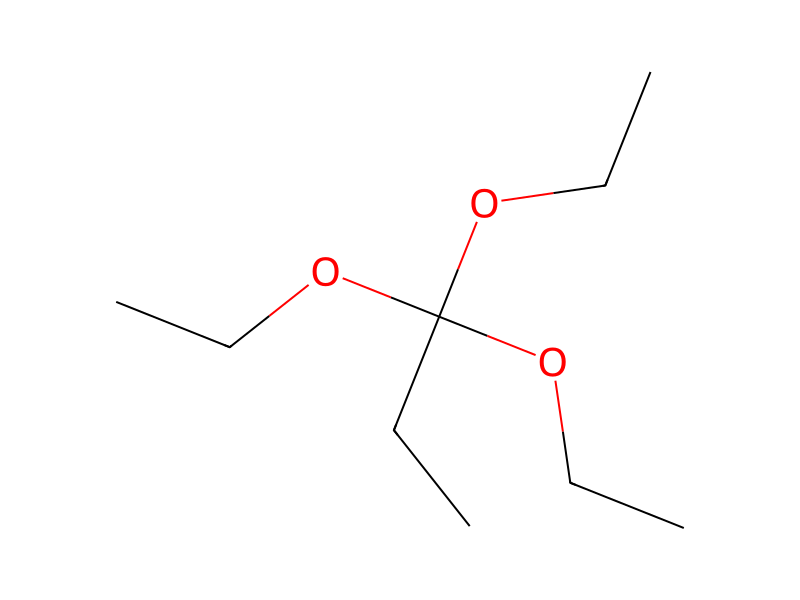
Ethyl orthopropionate → HCID 13385689, compound
Reaction equation

[Cl:1][C:2]1[CH:3]=[C:4]2[C:9](=[CH:10][CH:11]=1)[N:8]=[C:7]([NH:12][NH2:13])[C:6]([O:14][CH3:15])=[N:5]2.[C:16](OCC)(OCC)(OCC)[CH2:17][CH3:18]>>[Cl:1][C:2]1[CH:3]=[C:4]2[C:9](=[CH:10][CH:11]=1)[N:8]1[C:16]([CH2:17][CH3:18])=[N:13][N:12]=[C:7]1[C:6]([O:14][CH3:15])=[N:5]2Participants
3


Conditions
- Temperature
- 100 °C
Procedure
A mixture consisting of 5.1 g. (0.022 mole) of 6-chloro-2-hydrazino-3-methoxyquinoxaline, the product of Preparation C(d), and 60 ml. of triethyl orthopropionate was heated with mechanical stirring in a preheated oil bath at 100° C. overnight (~16 hours). The resulting mixture was then cooled to room temperature (~20° C.), and the precipitate which formed was subsequently collected by means of suction filtration and washed with diethyl ether to ultimately afford 4.3 g. (75%) of pure 7-chloro-1-ethyl-4-methoxy-[1,2,4[4,3-a]quinoxaline, m.p. 221°-223° C.
Workup
- temperatureThe resulting mixture was then cooled to room temperature (~20° C.)
- customthe precipitate which formed
- filtrationwas subsequently collected by means of suction filtration
- washwashed with diethyl ether to ultimately afford 4.3 g
Sources & evidence
- ORD record
- ord-35444767da4243979acadf8b3bcbf84e
- Source dataset
- uspto-grants-1985_01
- Patent number
- US04495187
Reaction notes
Loading…