Ethylenediamine → 5-(4,5-Dihydro-1H-imidazol-2-yl)-1,3-dimethyl-4-nitro-1H-pyrazole
Reaction equation

[CH3:1][N:2]1[C:6]([C:7]([NH2:9])=O)=[C:5]([N+:10]([O-:12])=[O:11])[C:4]([CH3:13])=[N:3]1.F[B-](F)(F)F.C([O+](CC)CC)C.[CH2:26](N)[CH2:27][NH2:28]>C(Cl)Cl>[CH3:1][N:2]1[C:6]([C:7]2[NH:28][CH2:27][CH2:26][N:9]=2)=[C:5]([N+:10]([O-:12])=[O:11])[C:4]([CH3:13])=[N:3]1Participants
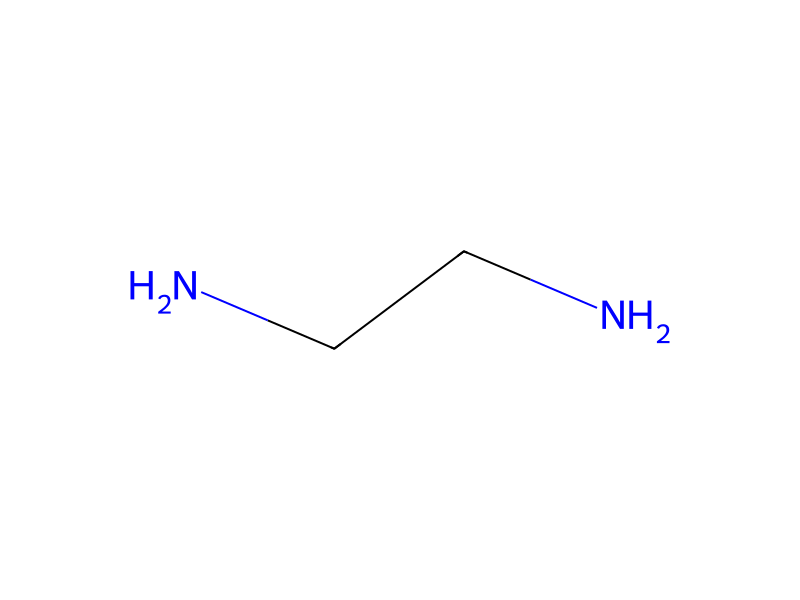



Conditions
- Temperature
- 20 °C
Procedure
1,3-Dimethyl-4-nitro-5-pyrazolecarboxamide (28 g, 0.15 mol) is added to a solution of 38 g (0.2 mol) of triethyloxonium fluoroborate in 250 ml of methylenedichloride. The mixture is stirred at 20° C. for six hours and evaporated in vacuo. The residue is dissolved in 200 ml of absolute ethanol and 18 g (0.3 mol) of ethylenediamine is added. The yellow solution is stirred overnight at 20° C. and the solvent is evaporated in vacuo. The residue is stirred in 300 ml of 2N hydrochloric acid and filtered from 11.5 g (41%) of recovered starting amide. The filtrate is made basic with sodium carbonate and extracted with methylenedichloride. Evaporation of the methylenedichloride gives 9 g of 2-(1,3-dimethyl-4-nitro-5-pyrazolyl)imidazoline, mp 143°-145° C. from ethyl acetate-pet ether.
Workup
- customevaporated in vacuo
- dissolutionThe residue is dissolved in 200 ml of absolute ethanol
- stirringThe yellow solution is stirred overnight at 20° C.
- customthe solvent is evaporated in vacuo
- stirringThe residue is stirred in 300 ml of 2N hydrochloric acid
- filtrationfiltered from 11.5 g (41%)
- customof recovered
- extractionextracted with methylenedichloride
- customEvaporation of the methylenedichloride
Sources & evidence
- ORD record
- ord-602b7c666e5b4a2a8ba641dec561a5e2
- Source dataset
- uspto-grants-1984_09
- Patent number
- US04469868
Reaction notes
Loading…