Benzenepropanal → HCID 12390942, compound
Reaction equation
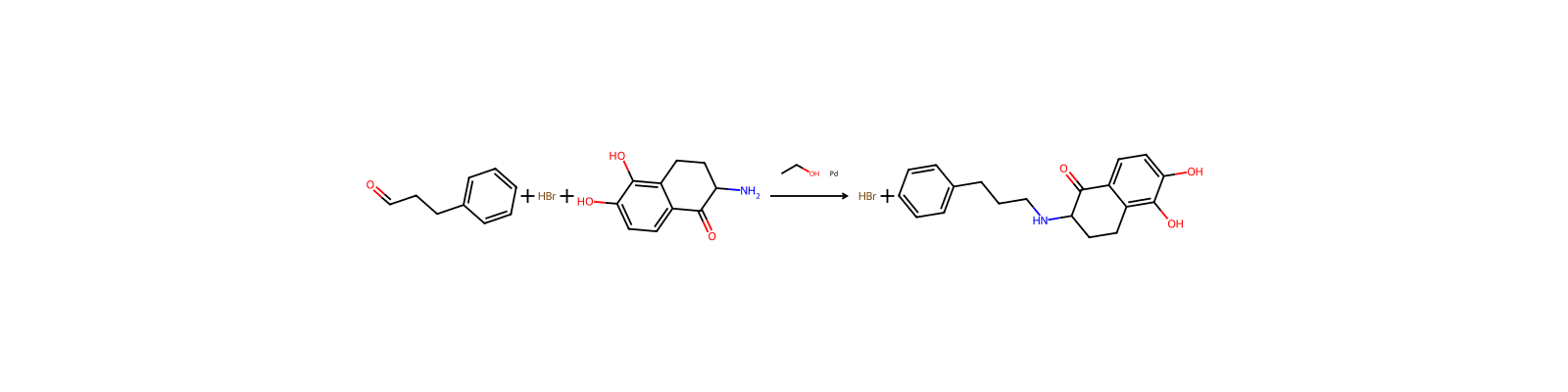
[C:1]1([CH2:7][CH2:8][CH:9]=O)[CH:6]=[CH:5][CH:4]=[CH:3][CH:2]=1.[BrH:11].[NH2:12][CH:13]1[CH2:22][CH2:21][C:20]2[C:15](=[CH:16][CH:17]=[C:18]([OH:24])[C:19]=2[OH:23])[C:14]1=[O:25]>C(O)C.[Pd]>[BrH:11].[C:1]1([CH2:7][CH2:8][CH2:9][NH:12][CH:13]2[CH2:22][CH2:21][C:20]3[C:15](=[CH:16][CH:17]=[C:18]([OH:24])[C:19]=3[OH:23])[C:14]2=[O:25])[CH:6]=[CH:5][CH:4]=[CH:3][CH:2]=1Participants
5
Reactant 2


Product 1

Reagents, catalysts & solvents 2


Procedure
In 300 volume parts of ethanol is dissolved 5 parts of 2-amino-5,6-dihydroxy-3,4-dihydro-1(2H)-naphthalenone hydrobromide and, after the addition of 50 parts of β-phenylpropionaldehyde, catalytic reduction is carried out at ordinary temperature and pressure using palladium-on-carbon as a catalyst. When a stoichiometric amount of hydrogen has been absorbed, the reaction mixture is filtered and the filtrate is concentrated under reduced pressure. The procedure yields 3.5 parts of 2-(3-phenylpropyl)amino-5,6-dihydroxy-3,4-dihydro-1(2H)-naphthalenone hydrobromide as colorless crystals melting at 215°-217° C.
Workup
- customWhen a stoichiometric amount of hydrogen has been absorbed
- filtrationthe reaction mixture is filtered
- concentrationthe filtrate is concentrated under reduced pressure
Sources & evidence
- ORD record
- ord-ad365389a9d4424da3eea093dc7ba5ff
- Source dataset
- uspto-grants-1978_08
- Patent number
- US04104402
Reaction notes
Loading…