Hydrazine → 5-[4-(1H-Pyrazol-1-yl)benzyl]-2,5-dihydro-3H-pyrazolo[4,3-c]cinnolin-3-one
Reaction equation
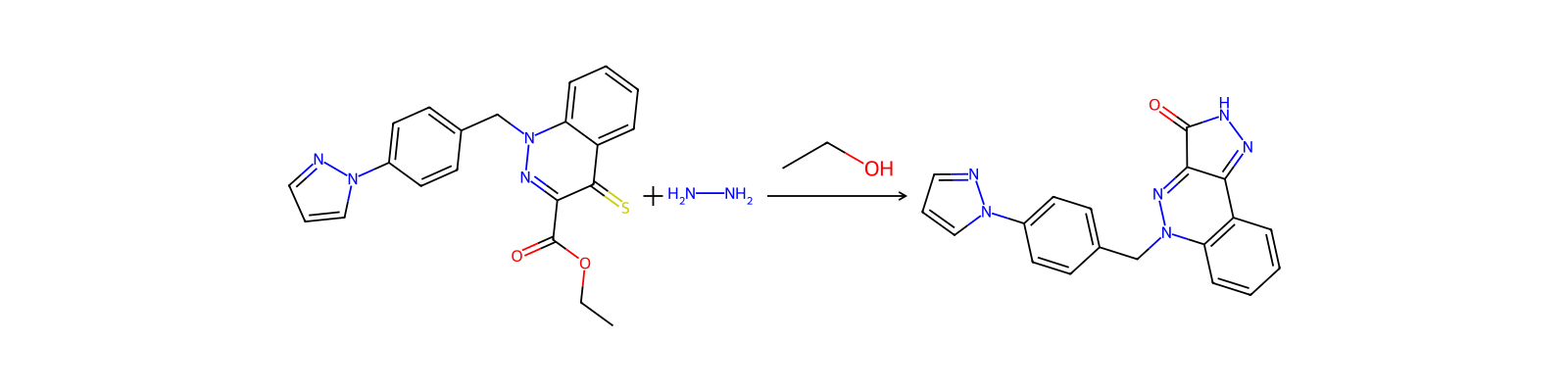
[N:1]1([C:6]2[CH:28]=[CH:27][C:9]([CH2:10][N:11]3[C:20]4[C:15](=[CH:16][CH:17]=[CH:18][CH:19]=4)[C:14](=S)[C:13]([C:22]([O:24]CC)=O)=[N:12]3)=[CH:8][CH:7]=2)[CH:5]=[CH:4][CH:3]=[N:2]1.[NH2:29][NH2:30]>C(O)C>[N:1]1([C:6]2[CH:7]=[CH:8][C:9]([CH2:10][N:11]3[C:20]4[CH:19]=[CH:18][CH:17]=[CH:16][C:15]=4[C:14]4=[N:29][NH:30][C:22](=[O:24])[C:13]4=[N:12]3)=[CH:27][CH:28]=2)[CH:5]=[CH:4][CH:3]=[N:2]1Participants
4




Conditions
- Temperature
- 70 °C
Procedure
Ethyl 1-[4-(1H-pyrazol-1-yl)benzyl]-4-thioxo-1,4-dihydrocinnoline-3-carboxylate [(Example 31, Step 4) 449 mg, 1.15 mmol] was dissolved in ethanol (12.0 mL) and treated with hydrazine (0.61 mL, 19.57 mmol, 17 equiv). The mixture was stirred at 70° C. for 30 minutes then cooled to ambient temperature and concentrated in vacuo. The residue was suspended in ethyl acetate and filtered. The resulting solid was washed with dichloromethane and dried under in vacuo to afford the titled compound as a dark red powder.
Workup
- temperaturethen cooled to ambient temperature
- concentrationconcentrated in vacuo
- filtrationfiltered
- washThe resulting solid was washed with dichloromethane
- customdried under in vacuo
Sources & evidence
- ORD record
- ord-22ac86e56d6c49678d96d9a6b007a3fa
- Source dataset
- uspto-grants-2014_02
- Patent number
- US08653079B2
Reaction notes
Loading…