Lawesson's reagent → Ethyl-8-chloro-1-(4-iodobenzyl)-4-thioxo-1,4-dihydrocinnoline-3-carboxylate
Reaction equation
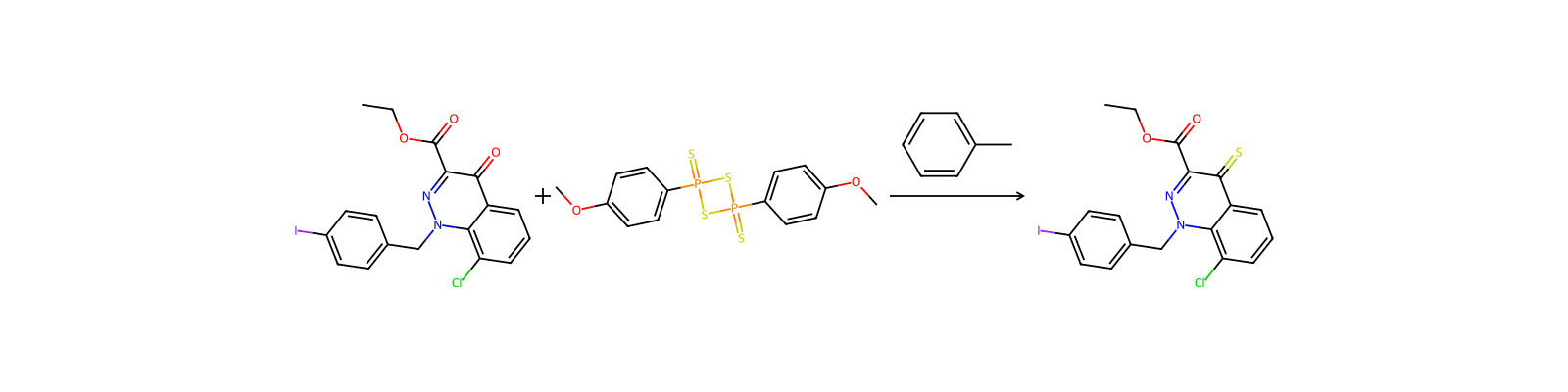
[CH2:1]([O:3][C:4]([C:6]1[C:15](=O)[C:14]2[C:9](=[C:10]([Cl:17])[CH:11]=[CH:12][CH:13]=2)[N:8]([CH2:18][C:19]2[CH:24]=[CH:23][C:22]([I:25])=[CH:21][CH:20]=2)[N:7]=1)=[O:5])[CH3:2].COC1C=CC(P2(SP(C3C=CC(OC)=CC=3)(=S)S2)=[S:35])=CC=1>C1(C)C=CC=CC=1>[CH2:1]([O:3][C:4]([C:6]1[C:15](=[S:35])[C:14]2[C:9](=[C:10]([Cl:17])[CH:11]=[CH:12][CH:13]=2)[N:8]([CH2:18][C:19]2[CH:24]=[CH:23][C:22]([I:25])=[CH:21][CH:20]=2)[N:7]=1)=[O:5])[CH3:2]Participants
4



Procedure
Ethyl-8-chloro-1-(4-iodobenzyl)-4-oxo-1,4-dihydrocinnoline-3-carboxylate (736 mg, 1.57 mmol) and Lawesson's Reagent (445 mg, 1.10 mmol, 0.7 equiv) were combined in toluene (8 mL) and placed into an oil bath preheated at 105° C. for 15 minutes. The mixture was cooled to ambient temperature, concentrated in vacuo and the residue was purified by silica gel gradient chromatography (100:0 to 40:60; hexanes:ethyl acetate), providing the titled compound.
Workup
- customplaced into an oil bath
- concentrationconcentrated in vacuo
- customthe residue was purified by silica gel gradient chromatography (100:0 to 40:60; hexanes:ethyl acetate)
Sources & evidence
- ORD record
- ord-11296843bcb745b092905d698403cf65
- Source dataset
- uspto-grants-2014_02
- Patent number
- US08653079B2
Reaction notes
Loading…