2,5-Dibromo-3-nitropyridine → 5-Bromo-3-nitropyridine-2-carbonitrile
Reaction equation

Br[C:2]1[C:7]([N+:8]([O-:10])=[O:9])=[CH:6][C:5]([Br:11])=[CH:4][N:3]=1.[Cu](C#N)[C:13]#[N:14]>>[Br:11][C:5]1[CH:6]=[C:7]([N+:8]([O-:10])=[O:9])[C:2]([C:13]#[N:14])=[N:3][CH:4]=1Participants
3


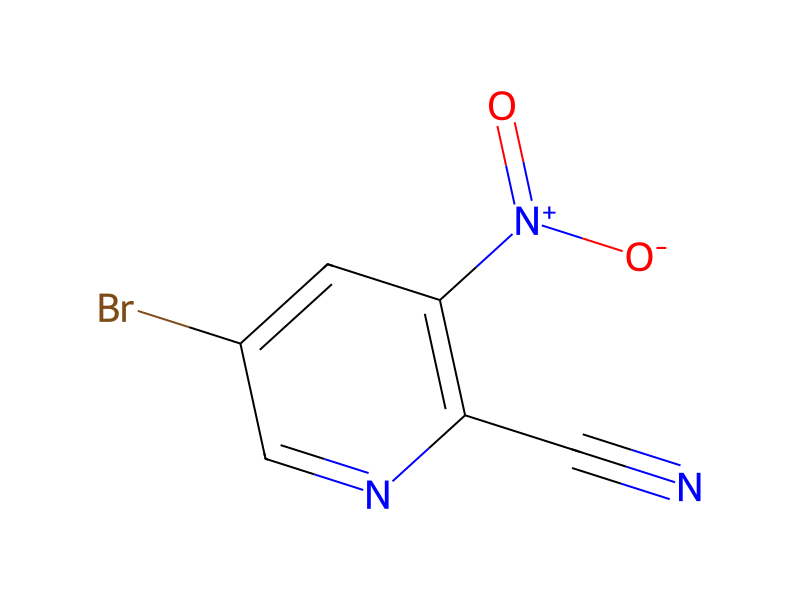
Conditions
- Temperature
- 150 °C
Procedure
2,5-Dibromo-3-nitropyridine (3.80 g, 13.4 mmol) and copper cyanide (2.42 g, 26.8 mmol) were mixed, and stirred under heat at 150° C. for 2 hours. After cooled to room temperature, the contents were filtered, and the residue was washed with acetone. The mother liquid was concentrated, and the resulting residue was purified through silica gel column chromatography (hexane/ethyl acetate=9/1 to 3/1) to obtain the intended compound (1.80 g, 59%) as a yellow solid.
Workup
- temperatureAfter cooled to room temperature
- filtrationthe contents were filtered
- washthe residue was washed with acetone
- concentrationThe mother liquid was concentrated
- customthe resulting residue was purified through silica gel column chromatography (hexane/ethyl acetate=9/1 to 3/1)
Sources & evidence
- ORD record
- ord-5f4cb9f67e6645d99dccb1313a9a85b4
- Source dataset
- uspto-grants-2011_06
- Patent number
- US07960394B2
Reaction notes
Loading…