Toluene → [4-(5-Chloro-2-methoxy-pyridin-3-yl)-3-methoxy-benzyl]-carbamic acid tert-butyl ester
Reaktionsgleichung

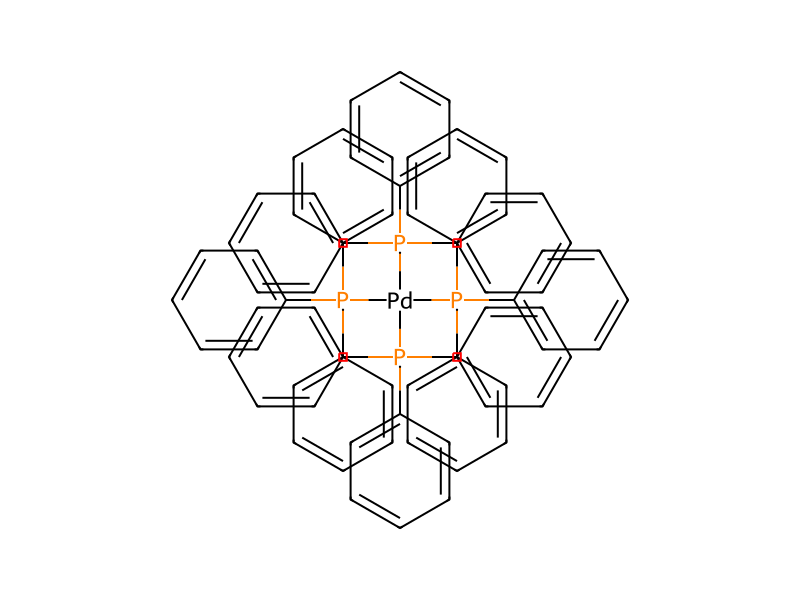
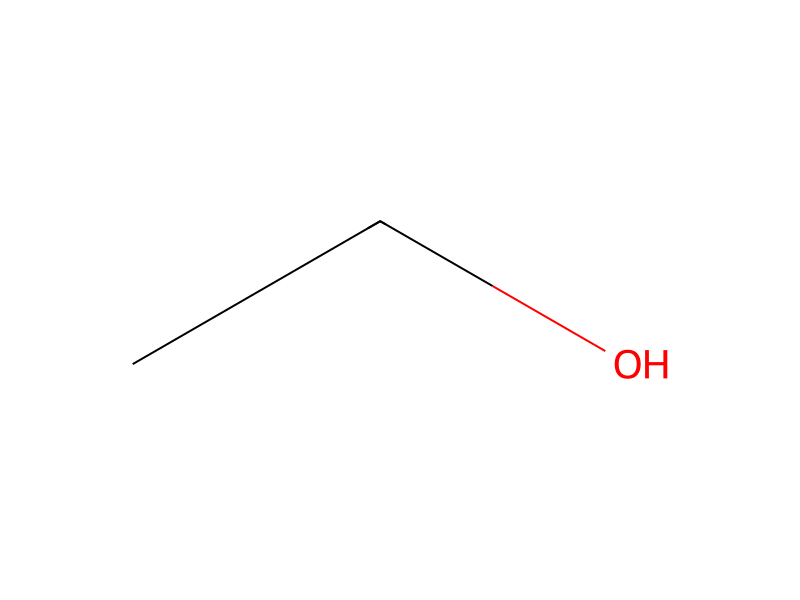
[C:1]([O:5][C:6]([NH:8][CH2:9][C:10]1[CH:15]=[CH:14][C:13](OS(C(F)(F)F)(=O)=O)=[C:12]([O:24][CH3:25])[CH:11]=1)=[O:7])([CH3:4])([CH3:3])[CH3:2].[Cl:26][C:27]1[CH:28]=[C:29](B(O)O)[C:30]([O:33][CH3:34])=[N:31][CH:32]=1.C(=O)([O-])[O-].[Na+].[Na+].C1(C)C=CC=CC=1>C1C=CC([P]([Pd]([P](C2C=CC=CC=2)(C2C=CC=CC=2)C2C=CC=CC=2)([P](C2C=CC=CC=2)(C2C=CC=CC=2)C2C=CC=CC=2)[P](C2C=CC=CC=2)(C2C=CC=CC=2)C2C=CC=CC=2)(C2C=CC=CC=2)C2C=CC=CC=2)=CC=1.C(O)C>[C:1]([O:5][C:6](=[O:7])[NH:8][CH2:9][C:10]1[CH:15]=[CH:14][C:13]([C:29]2[C:30]([O:33][CH3:34])=[N:31][CH:32]=[C:27]([Cl:26])[CH:28]=2)=[C:12]([O:24][CH3:25])[CH:11]=1)([CH3:4])([CH3:3])[CH3:2]Komponenten
Edukt 4
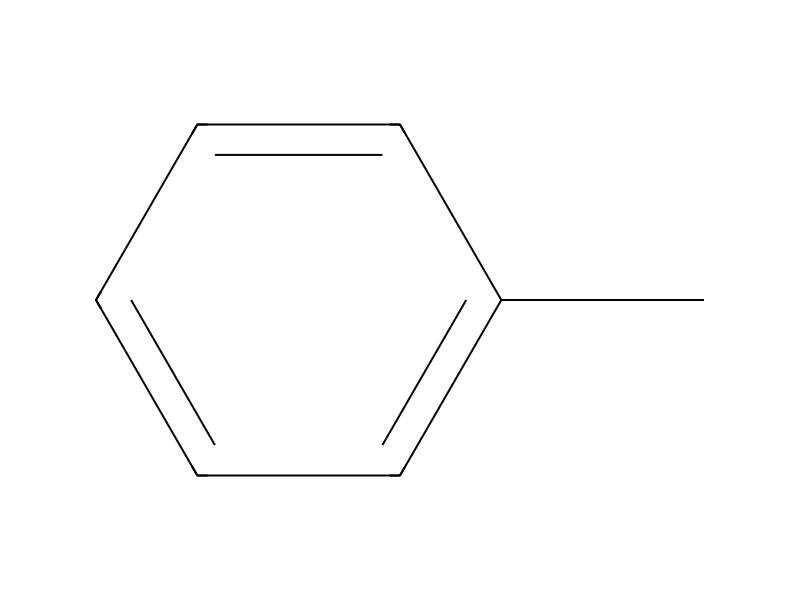
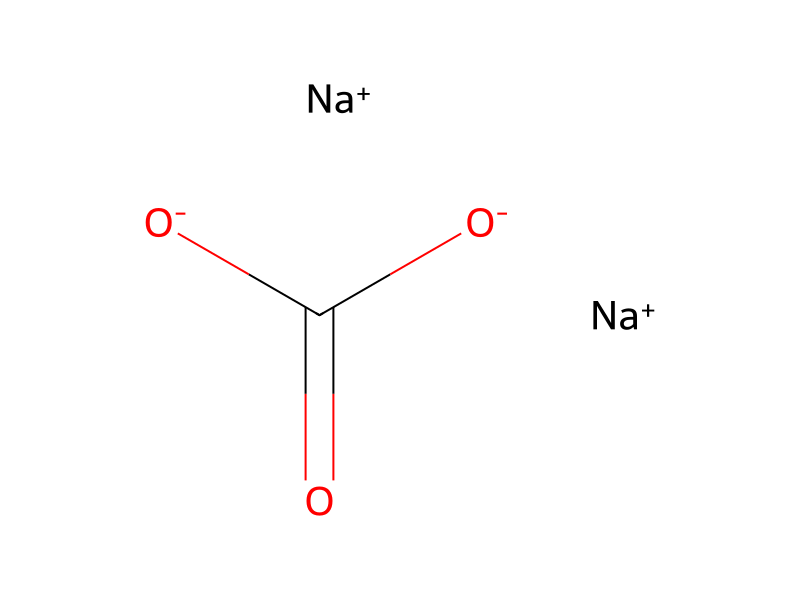


Produkt 1

Reagenzien, Katalysatoren, Lösungsmittel 2
Reaktionsbedingungen
- Temperatur
- 120 °C
Versuchsvorschrift
A mixture of 3-methoxy-4-hydroxybenzaldehyde (0.406 g, 2.67 mmol), N-phenyl-bis (trifluoromethane)sulfonimide) (0.953 g, 2.67 mmol) and potassium carbonate (0.74 g, 5.3 mmol) in tetrahydrofuran (4.0 ml) was heated in a microwave oven at 120° C. for 10 min. The mixture was partitioned between ethyl acetate and dilute aqueous sodium hydroxide solution. The organic phase was washed with water, dried over anhydrous sodium sulfate and the solvent evaporated to give the trifluoro-methanesulfonic acid 4-formyl-2-methoxy-phenyl ester. A mixture of trifluoro-methanesulfonic acid 4-formyl-2-methoxy-phenyl ester (1.00 g, 3.52 mmol), titanium tetraethoxide (1.61 g, 7.04 mmol) and 2-methyl-2-propanesulfinamide (0.94 g, 7.75 mmol) in tetrahydrofuran (10 ml) was heated under reflux for 2 h, and then stirred at ambient temperature overnight. Further titanium tetraethoxide (0.80 g, 3.52 mmol) was added and the mixture stirred at ambient temperature overnight. The mixture was cooled in ice and then added portionwise to a stirred mixture of sodium borohydride (0.53 g, 14.1 mmol) in tetrahydrofuran (10 ml) at −78° C. The solution was allowed to warm to ambient temperature, treated slowly with water (with cooling) and extracted with ethyl acetate. The combined organic extracts were washed brine, dried over anhydrous sodium sulfate and the solvent evaporated. The residue was dissolved in methanol (10 ml), and treated with 2M hydrogen chloride in diethyl ether solution (5 ml). After standing for 2 hours, the solvent was evaporated, the residue triturated with diethyl ether, and the solid filtered and dried to give trifluoro-methanesulfonic acid 4-aminomethyl-2-methoxy-phenyl ester hydrochloride. A stirred solution of trifluoro-methanesulfonic acid 4-aminomethyl-2-methoxy-phenyl ester hydrochloride (0.37 g, 1.29 mmol) and triethylamine (0.4 ml, 2.7 mmol) in dichloromethane (10 ml) was treated with di-tert-butyl dicarbonate (0.28 g, 1.29 mmol) and stirred at ambient temperature overnight. The solvent was evaporated and the residue partitioned between ethyl acetate and water. The organic phase was washed with water, dried over anhydrous sodium sulfate and the solvent evaporated to give trifluoro-methanesulfonic acid 4-(tert-butoxycarbonylamino-methyl)-2-methoxy-phenyl ester. A mixture of trifluoro-methanesulfonic acid 4-(tert-butoxycarbonylamino-methyl)-2-methoxy-phenyl ester (0.20 g, 0.52 mmol), 5-chloro-2-methoxy-pyridine-3-boronic acid (0.19 g, 1.0 mmol), tetrakis(triphenylphosphine)palladium (0) (0.073 g, 0.06 mmol), 2M aqueous sodium carbonate solution (2 ml), toluene (1 ml) and ethanol (1 ml) was heated in a microwave oven at 120° C. for 15 min. The mixture was partitioned between ethyl acetate and dilute aqueous sodium hydroxide solution. The organic phase was dried over anhyrous sodium sulfate, the solvent evaporated and the residue flash chromatographed over silica gel eluting with 1:1 heptane/ethyl acetate eluant to give the [4-(5-chloro-2-methoxy-pyridin-3-yl)-3-methoxy-benzyl]-carbamic acid tert-butyl ester. A solution of [4-(5-chloro-2-methoxy-pyridin-3-yl)-3-methoxy-benzyl]-carbamic acid tert-butyl ester (0.15 g, 0.4 mmol) in dichloromethane (10 ml) was treated with trifluoromethylacetic acid (0.5 ml), stirred at ambient temperature overnight, and the solvent evaporated to give 4-(5-chloro-2-methoxy-pyridin-3-yl)-3-methoxy-benzylamine trifluoromethyl acetate. The title compound was prepared in a similar manner to 5-chloro-1,3-dimethyl-1H-pyrazole-4-sulfonic acid (5′-chloro-3,2′-dimethoxy-biphenyl-4-ylmethyl)-amide (Example 41) using 4-(5-chloro-2-methoxy-pyridin-3-yl)-3-methoxy-benzylamine trifluoromethyl acetate instead of (5′-chloro-3,2′-dimethoxy-biphenyl-4-yl)-methylamine and 3,5-dimethylisoxazole-4-sulfonyl chloride instead of 5-chloro-1,3-dimethyl-1h-pyrazole-4-sulfonyl chloride. MS (ESI) m/z: 438.1 [M+H]+.
Aufarbeitung
- customThe mixture was partitioned between ethyl acetate and dilute aqueous sodium hydroxide solution
- dry with materialThe organic phase was dried over anhyrous sodium sulfate
- customthe solvent evaporated
- customthe residue flash chromatographed over silica gel eluting with 1:1 heptane/ethyl acetate eluant
Quellen und Nachweise
- ORD-Eintrag
- ord-6dccaa5d165143d1bb1e63e816432131
- Quelldatensatz
- uspto-grants-2011_06
- Patentnummer
- US07960365B2
Notizen zur Reaktion
Wird geladen…