2-(Trifluoromethyl)benzeneboronic acid → [1,1'-Biphenyl]-4-sulfonamide, N-(5-hydroxypentyl)-2'-(trifluoromethyl)-
Reaction equation
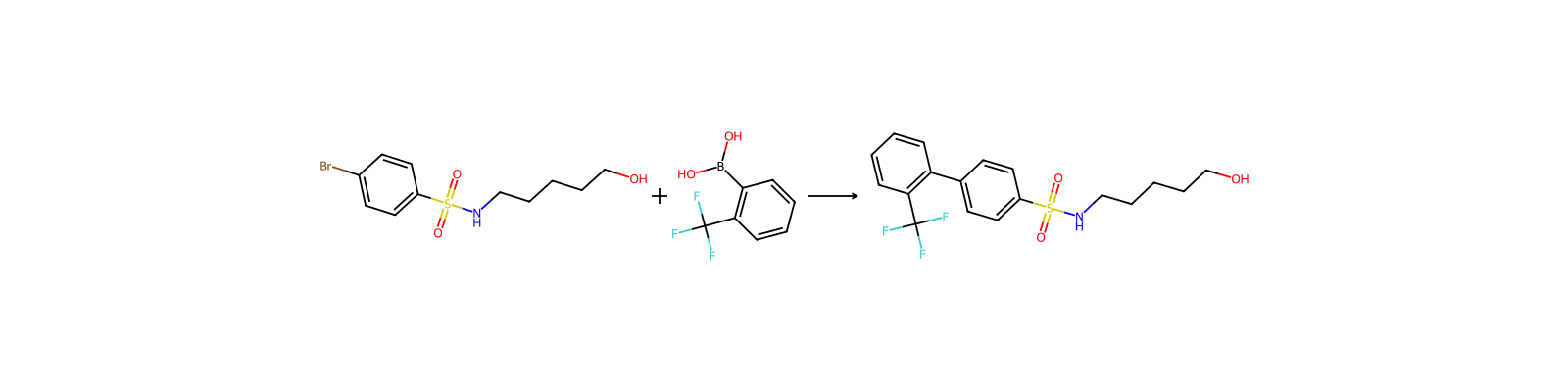
[OH:1][CH2:2][CH2:3][CH2:4][CH2:5][CH2:6][NH:7][S:8]([C:11]1[CH:16]=[CH:15][C:14](Br)=[CH:13][CH:12]=1)(=[O:10])=[O:9].[F:18][C:19]([F:30])([F:29])[C:20]1[CH:25]=[CH:24][CH:23]=[CH:22][C:21]=1B(O)O>>[OH:1][CH2:2][CH2:3][CH2:4][CH2:5][CH2:6][NH:7][S:8]([C:11]1[CH:16]=[CH:15][C:14]([C:21]2[CH:22]=[CH:23][CH:24]=[CH:25][C:20]=2[C:19]([F:30])([F:29])[F:18])=[CH:13][CH:12]=1)(=[O:10])=[O:9]Participants
3


Procedure
Using a method analogous to that described in Example 40, 4-bromophenyl-sulfonic acid-(5-hydroxypentyl)-amide and 2-trifluoromethylphenyl boronic acid were reacted to give the title compound as a white solid. δC (DMSO, 62.9 MHz): 22.6, 28.9, 32.0, 42.7, 60.5, 121.9, 126.2, 126.5, 127.1, 128.8, 129.8, 132.0, 132.6, 139.2, 140.2 and 143.1.
Workup
- customwere reacted
Sources & evidence
- ORD record
- ord-6074593758574e6a8b273453c830b49f
- Source dataset
- uspto-grants-2011_06
- Patent number
- US07964643B2
Reaction notes
Loading…