4-Amino-1-butanol → 4-Bromo-N-(4-hydroxybutyl)-2-(trifluoromethoxy)benzene-1-sulfonamide
Reaction equation
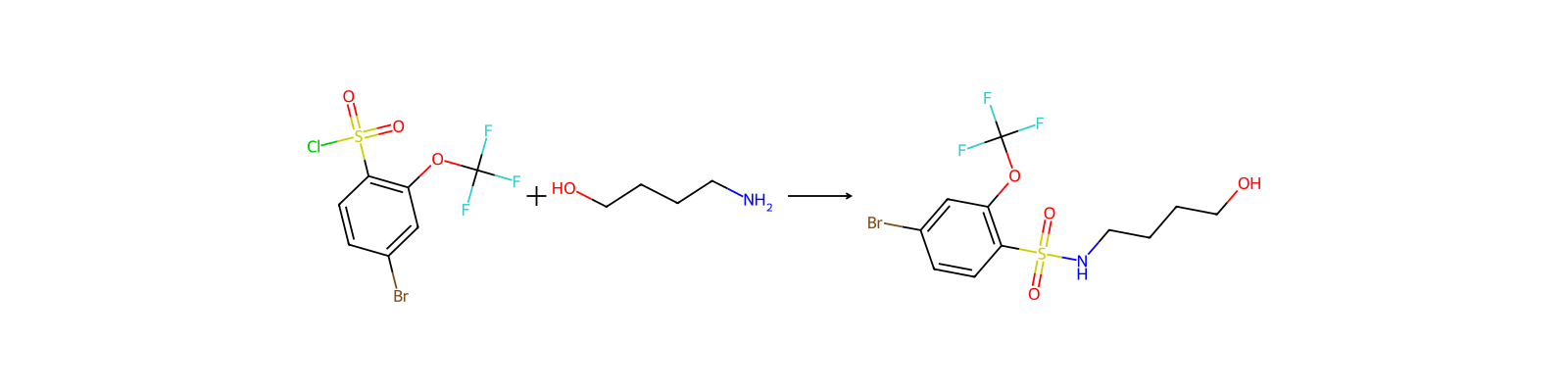
[Br:1][C:2]1[CH:7]=[CH:6][C:5]([S:8](Cl)(=[O:10])=[O:9])=[C:4]([O:12][C:13]([F:16])([F:15])[F:14])[CH:3]=1.[NH2:17][CH2:18][CH2:19][CH2:20][CH2:21][OH:22]>>[OH:22][CH2:21][CH2:20][CH2:19][CH2:18][NH:17][S:8]([C:5]1[CH:6]=[CH:7][C:2]([Br:1])=[CH:3][C:4]=1[O:12][C:13]([F:16])([F:15])[F:14])(=[O:10])=[O:9]Participants
3


Procedure
Using a method analogous to that described in Example 1, 4-bromo-2-trifluoromethoxyphenyl sulphonyl chloride was reacted with 4-aminobutanol, and the title compound obtained as a white solid after recrystallisation from ether/petrol. δC (CDCl3, 62.9 MHz): 26.5, 29.4, 43.3, 62.1, 127.3, 131.7, 131.7, 133.1, 135.4 and 137.9.
Sources & evidence
- ORD record
- ord-dd6aef83130f4de18be795b5bf3aafbf
- Source dataset
- uspto-grants-2011_06
- Patent number
- US07964643B2
Reaction notes
Loading…