Participants
| Role | Name | HCID | Charge |
|---|
| Reactant | Acetate | HCID 175 | — |
| Reactant | Triphenylphosphine | HCID 11776 | — |
| Reactant | 1,3-Cyclopentanedione | HCID 77466 | — |
| Reactant | 1,8-Diazabicyclo(5.4.0)undec-7-ene | HCID 81184 | — |
| Catalyst | palladium(II) acetate | HCID 167845 | — |
| Solvent | Diethyl Ether | HCID 3283 | — |
| Solvent | Tetrahydrofuran | HCID 8028 | — |
| Product | HCID 11008759 | HCID 11008759 | — |
Reaction Steps
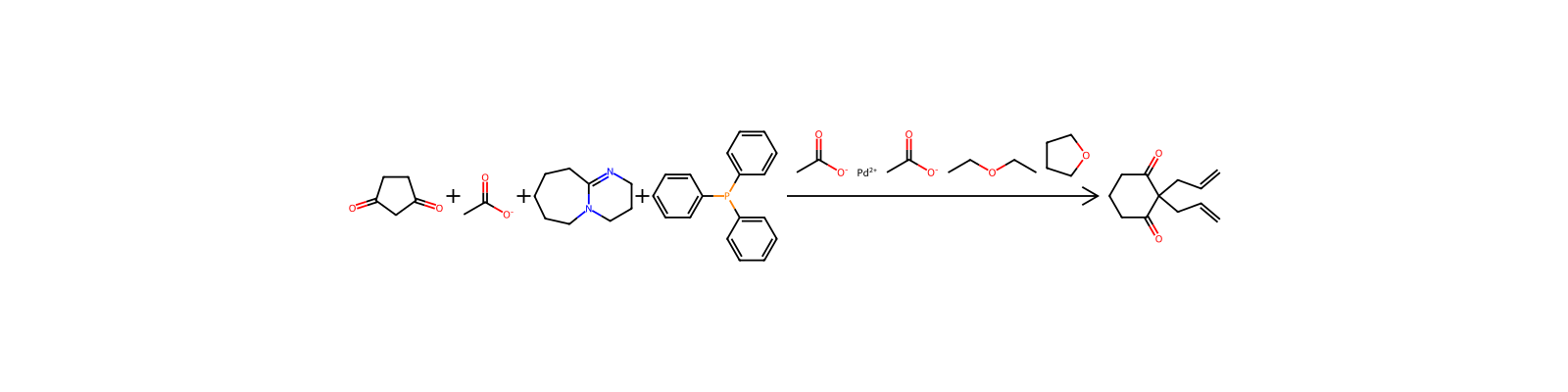
There were put 1.1 g of 1,3-cyclopentandione manufactured by Tokyo Chemical Industry Co., Ltd., and 20 mL of dry tetrahydrofuran manufactured by Kanto Chemical Co., Inc. in a 100 mL round-bottom flask. To the resultant mixture, 3.3 mL of ally acetate manufactured by Tokyo Chemical Industry Co., Ltd., 3.3 mL of 1,8-diazabicyclo[5.4.0]undec-7-ene manufactured by Tokyo Chemical Industry Co., Ltd., 10.55 mg of palladium acetate manufactured by N.E. Chemcat Corporation, and 49.31 mL of triphenylphosphine manufactured by Kanto Chemical Co., Inc. were added. The mixture was stirred for 23 hours at a room temperature under a nitrogen atmosphere. There was added 20 mL of ether to the reaction mixture, and the resultant mixture was washed twice with each 20 mL of saturated aqueous ammonium chloride. The washed mixture was further washed with 20 mL of water, and was further washed with 20 mL of a saturated sodium chloride solution. The washed mixture was dried over magnesium sulfate. The dried mixture was subjected to evaporation to remove the solvents contained therein. The obtained liquid was distilled in vacuo, thereby obtaining 1.85 g of 2,2-diallylcyclohexan-1,3-dione as a colorless and oily fraction at 55° C. under a pressure of 4 mmHg.
Provenance & Evidence
| DOI | 10.6084/m9.figshare.5104873.v1 |
|---|
| Patent number | US07964691B2 |
|---|
| Source dataset | uspto-grants-2011_06 |
|---|
| ORD ID | ord-d97eded8aab44d50874a1bab92715d46 |
|---|
| Source note | uspto-grants-2011_06 |
|---|