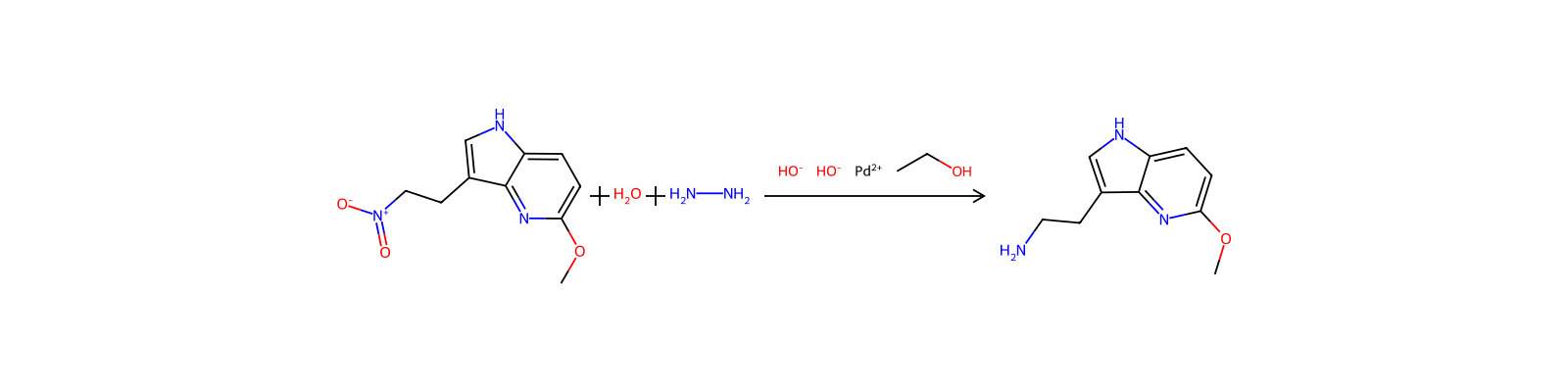
Participants
| Role | Name | HCID | Charge |
|---|
| Reactant | Hydrazine hydrate (1:1) | HCID 24654 | — |
| Reactant | HCID 639514 | HCID 639514 | — |
| Catalyst | Palladium hydroxide | HCID 9942167 | — |
| Solvent | Ethanol | HCID 702 | — |
| Product | 1171071-94-5 | HCID 67255191 | — |
Reaction Steps
An ethanol (20 mL) suspension of 5-methoxy-3-(2-nitroethyl)-1H-pyrrolo[3,2-b]pyridine (1.11 g) and palladium hydroxide/carbon (550 mg) was heated to 80° C. and an ethanol (2 mL) solution of hydrazine monohydrate (628 mg) was added dropwise, followed by stirring at 80° C. for one hour. The reaction mixture was air-cooled to room temperature, filtered with Celite (trade name), and then filtrate was concentrated to obtain [2-(5-methoxy-1H-pyrrolo[3,2-b]pyridin-3-yl)ethyl]amine. The resulting product was dissolved in N,N-dimethylformamide (15 mL) and 3-fluorobenzoic acid (802 mg), HOAt (751 mg) and EDC hydrochloride (1.06 g) were sequentially added, followed by stirring at room temperature until materials disappear. To the reaction mixture, a cold aqueous saturated sodium hydrogen carbonate solution was added, followed by extraction with ethyl acetate. The organic layer was washed with saturated saline, dried over anhydrous sodium sulfate and then concentrated. The residue was dissolved in methanol (15 mL) and an aqueous 1N sodium hydroxide solution (3 mL) was added, followed by stirring for fifteen minutes. The reaction mixture was diluted with water and then extracted with ethyl acetate. The organic layer was washed with saturated saline, dried over anhydrous sodium sulfate and then concentrated. The residue was purified by silica gel column chromatography (hexane:ethyl acetate=1:1) to obtain 3-fluoro-N-[2-(5-methoxy-1H-pyrrolo[3,2-b]pyridin-3-yl)ethyl]benzamide. The resulting product was dissolved in anhydrous acetonitrile (76 mL) and N,N-diethylaniline (two drops) was added, followed by deaeration with ultrasonic wave, argon substitution and further addition of phosphorus oxychloride (2.33 mL), followed by stirring at 80 to 85° C. overnight. The reaction mixture was air-cooled to room temperature and then concentrated. After the residue was dissolved in a mixed solvent of tetrahydrofuran and ethyl acetate, the solution was washed with an aqueous saturated sodium hydrogen carbonate solution and saturated saline, dried over anhydrous sodium sulfate and then concentrated to obtain a mixture of 6-(3-fluorophenyl)-2-methoxy-8,9-dihydro-5H-pyrido[4′,3′:4,5]pyrrolo[3,2-b]pyridine and 2-chloro-6-(3-fluorophenyl)-8,9-dihydro-5H-pyrido[4′,3′:4,5]pyrrolo[3,2-b]pyridine. The mixture was dissolved in methanol (14 mL) and sodium borohydride (469 mg) was added at room temperature, followed by stirring until materials disappear. To the reaction mixture, an aqueous saturated sodium hydrogen carbonate solution was added, followed by extraction with ethyl acetate. The organic layer was washed with saturated saline, dried over anhydrous sodium sulfate and then concentrated to obtain a mixture of 6-(3-fluorophenyl)-2-methoxy-6,7,8,9-tetrahydro-5H-pyrido[4′,3′:4,5]pyrrolo[3,2-b]pyridine and 2-chloro-6-(3-fluorophenyl)-6,7,8,9-tetrahydro-5H-pyrido[4′,3′:4,5]pyrrolo[3,2-b]pyridine. The mixture was dissolved in tetrahydrofuran (13 mL) and di-tert-butyl dicarbonate (960 mg) was added at room temperature, followed by stirring until materials disappear. The reaction mixture was concentrated. The residue was purified by silica gel column chromatography (hexane:ethyl acetate=5:1) to obtain the titled compound A (444 mg) and the titled compound B (650 mg), each having the following physical properties.
Provenance & Evidence
| DOI | 10.6084/m9.figshare.5104873.v1 |
|---|
| Patent number | US07964726B2 |
|---|
| Source dataset | uspto-grants-2011_06 |
|---|
| ORD ID | ord-bab84f8c95cd4a588df9ff6be876085a |
|---|
| Source note | uspto-grants-2011_06 |
|---|