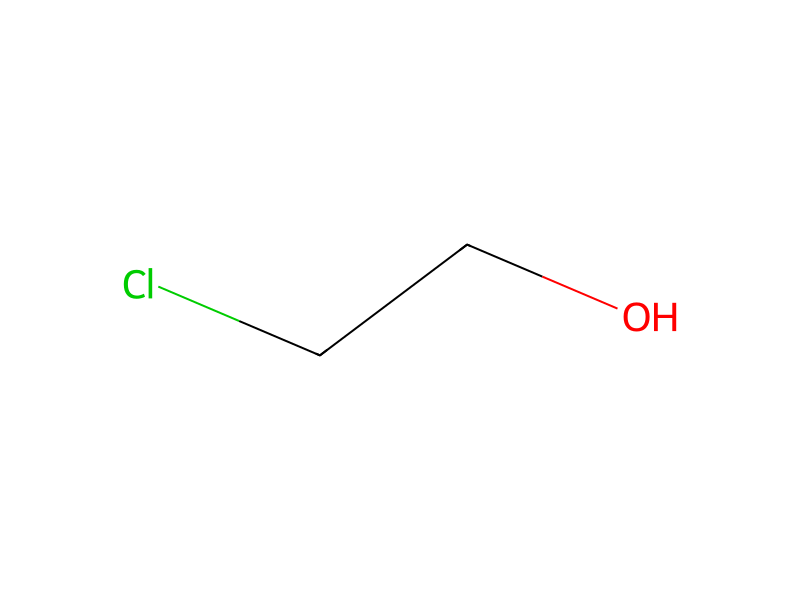
2-Chloroethanol → 3-[p-(2-Hydroxyethoxy)benzoyl]indole
Reaction equation

[OH:1][C:2]1[CH:18]=[CH:17][C:5]([C:6]([C:8]2[C:16]3[C:11](=[CH:12][CH:13]=[CH:14][CH:15]=3)[NH:10][CH:9]=2)=[O:7])=[CH:4][CH:3]=1.[OH-].[Na+].Cl[CH2:22][CH2:23][OH:24]>C(O)C.O>[OH:24][CH2:23][CH2:22][O:1][C:2]1[CH:3]=[CH:4][C:5]([C:6]([C:8]2[C:16]3[C:11](=[CH:12][CH:13]=[CH:14][CH:15]=3)[NH:10][CH:9]=2)=[O:7])=[CH:17][CH:18]=1Participants
6
Reactant 3


Product 1

Reagents, catalysts & solvents 2


Procedure
7 g of 3-(p-hydroxybenzoyl)indole and 1.44 g of sodium hydroxide were dissolved in 200 ml of a mixture of ethanol and water (ethanol:water=1:1). 2.85 g of 2-chloroethanol was added to the solution followed by reflux for 3 hours in oil bath. The solvent was evaporated to dryness and the residue was extracted with water-ethyl acetate. The organic layer obtained was purified by column chromatography on silica gel to give a crude product. It was recrystallized from ethyl acetate to obtain 3-[p-(2-hydroxyethoxy)benzoyl]indole (compound 15) in the form of white needle crystals. (Yield: 54%).
Workup
- temperatureby reflux for 3 hours in oil bath
- customThe solvent was evaporated to dryness
- extractionthe residue was extracted with water-ethyl acetate
- customThe organic layer obtained
- customwas purified by column chromatography on silica gel
- customto give a crude product
- customIt was recrystallized from ethyl acetate
Sources & evidence
- ORD record
- ord-7fdf8190dab0453a9ab273dd5be443c7
- Source dataset
- uspto-grants-1987_11
- Patent number
- US04708961
Reaction notes
Loading…