3-(Dimethylamino)-1,2-propanediol → Dodma
Reaktionsgleichung

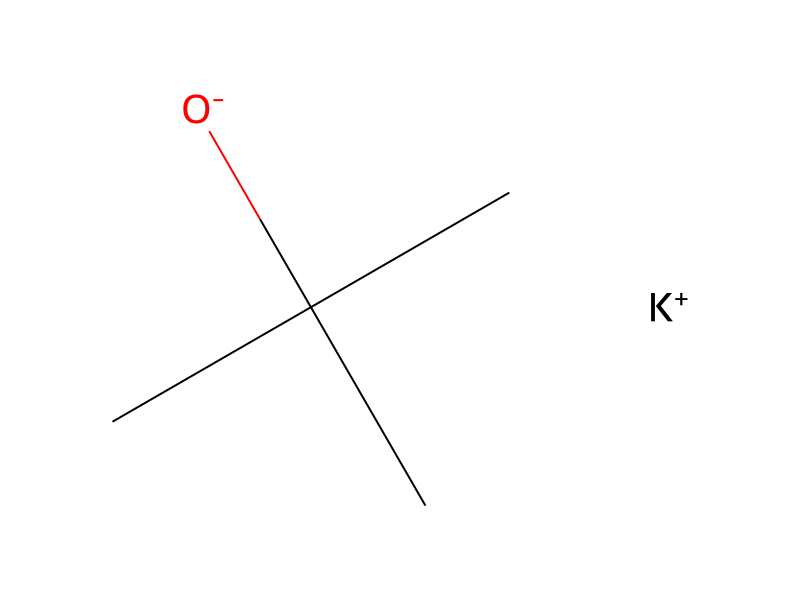
[CH3:1][CH2:2][CH2:3][CH2:4][CH2:5][CH2:6][CH2:7][CH2:8]/[CH:9]=[CH:10]\[CH2:11][CH2:12][CH2:13][CH2:14][CH2:15][CH2:16][CH2:17][CH2:18][O:19][CH2:20][CH:21]([O:27][CH2:28][CH2:29][CH2:30][CH2:31][CH2:32][CH2:33][CH2:34][CH2:35]/[CH:36]=[CH:37]\[CH2:38][CH2:39][CH2:40][CH2:41][CH2:42][CH2:43][CH2:44][CH3:45])[CH2:22][N+:23](C)([CH3:25])[CH3:24].[Cl-].CN(C)CC(O)CO.CC(C)([O-])C.[K+].C1(C)C=CC(S(OCCCCCCCC/C=C\CCCCCCCC)(=O)=O)=CC=1>>[CH2:28]([O:27][CH:21]([CH2:20][O:19][CH2:18][CH2:17][CH2:16][CH2:15][CH2:14][CH2:13][CH2:12][CH2:11]/[CH:10]=[CH:9]\[CH2:8][CH2:7][CH2:6][CH2:5][CH2:4][CH2:3][CH2:2][CH3:1])[CH2:22][N:23]([CH3:25])[CH3:24])[CH2:29][CH2:30][CH2:31][CH2:32][CH2:33][CH2:34][CH2:35]/[CH:36]=[CH:37]\[CH2:38][CH2:39][CH2:40][CH2:41][CH2:42][CH2:43][CH2:44][CH3:45]Komponenten



Versuchsvorschrift
DOTMA (N-(1-(2,3,-Dioleyloxy(propyl)-N,N,N-trimethylammonium chloride) was prepared as outlined. A mixture of 3-(dimethylamino)-1,2-propanediol (Aldrich Chemical Co., 1.19 g, 10 mmol), potassium tert-butoxide (3.36 g, 30 mmol) and oleyl p-toluenesulfonate (12.7 g, 30 mmol) in xylenes (50 ml) was stirred at room temperature and reduced pressure (30 Torr) for 30 min, and was then heated to 50° C. with stirring for an additional 15 min. The reaction vessel was purged with nitrogen, and the mixture was heated to reflux (approximately 140° C.) for 3 hrs. After cooling, the reaction mixture was diluted with hexane (100 ml), and the resulting solution was extracted with water (2×50 ml). The organic layer was concentrated, and the residue was chromatographed over silica gel by elution with a mixture of hexanes and ether (1:2) to afford the intermediate 2,3-dioleyloxy-1-(dimethylamino)-propane as a colorless oil. Quaternizaton was carried out by condensation of methyl chloride (50 ml) into a Parr pressure apparatus cooled to -78° C. containing this compound (10 g). The sealed vessel was heated behind a safety shield at 70° C. for 48 h. After cooling to 0° C., the reaction vessel was opened, and the excess methyl chloride was allowed to evaporate under a stream of nitrogen in a well-ventilated hood. The crude residue was recrystallized from acetonitrile to afford DOTMA as an off-white solid, mp. 35°-38° C. Full details of the synthesis of DOTMA and analogs will be published elsewhere (Gadek and Felgner, in preparation).
Aufarbeitung
- temperaturewas then heated to 50° C.
- stirringwith stirring for an additional 15 min
- customThe reaction vessel was purged with nitrogen
- temperaturethe mixture was heated
- temperatureto reflux (approximately 140° C.) for 3 hrs
- temperatureAfter cooling
- additionthe reaction mixture was diluted with hexane (100 ml)
- extractionthe resulting solution was extracted with water (2×50 ml)
- concentrationThe organic layer was concentrated
- customthe residue was chromatographed over silica gel by elution with a mixture of hexanes and ether (1:2)
Quellen und Nachweise
- ORD-Eintrag
- ord-08647475980b48d3a1f60dcc4cf3e7ec
- Quelldatensatz
- uspto-grants-1993_05
- Patentnummer
- US05208036
Notizen zur Reaktion
Wird geladen…