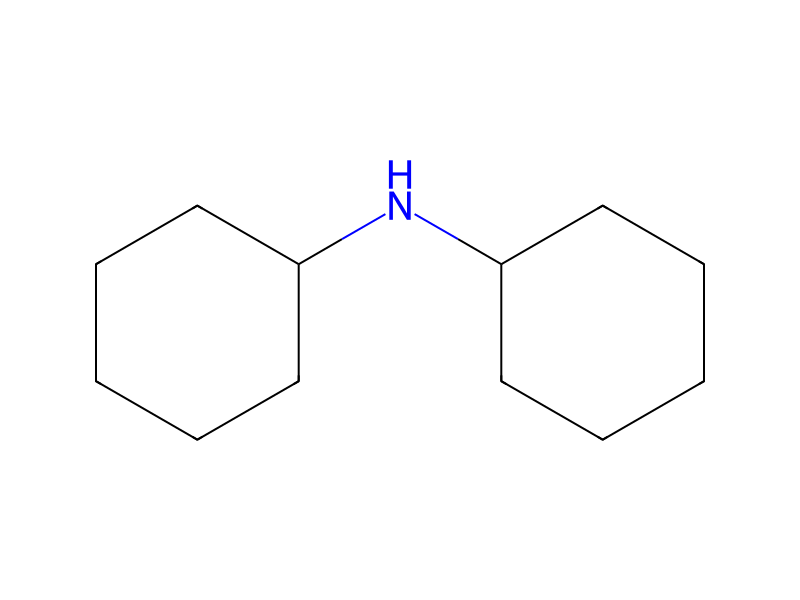
Dicyclohexylamine → HCID 19762694, compound
Reaction equation

[CH3:1][C:2]1([C:8]2[CH:9]=[C:10]([CH:14]=[CH:15][C:16]=2[O:17][CH3:18])[C:11](O)=[O:12])[CH2:7][CH2:6][CH2:5][CH2:4][CH2:3]1.C1(NC2CCCCC2)CCCCC1.S(Cl)([Cl:34])=O>ClCCl>[CH3:1][C:2]1([C:8]2[CH:9]=[C:10]([CH:14]=[CH:15][C:16]=2[O:17][CH3:18])[C:11]([Cl:34])=[O:12])[CH2:7][CH2:6][CH2:5][CH2:4][CH2:3]1Participants
5
Reactant 3


Product 1

Reagents, catalysts & solvents 1

Procedure
In a round bottom flask, there are introduced 4.96g (20 mmoles) of 3-(1-methylcyclohexyl)-4-methoxy benzoic acid, 75 ml of dichloromethane, and 4ml (20 mmoles) of dicyclohexylamine. The reaction mixture is stirred for 1 hour. To the resulting solution, there are added 1.45 ml (20 mmoles) of thionyl chloride (SOCl2 and the mixture is stirred for 2 hours at ambient temperature. The reaction mixture is then evaporated to dryness and taken up in 200 ml of ether. The dicyclohexyl-ammonium chloride is filtered off and the solvent is evaporated, yielding 5.30 g (100% yield) of crude 3-(1-methylcyclohexyl)-4-methoxy benzoyl chloride which is used, as is, for the following synthesis:
Workup
- stirringthe mixture is stirred for 2 hours at ambient temperature
- customThe reaction mixture is then evaporated to dryness
- filtrationThe dicyclohexyl-ammonium chloride is filtered off
- customthe solvent is evaporated
Sources & evidence
- ORD record
- ord-39d2b8ede5f24ab2b4e9a0f37eb6852e
- Source dataset
- uspto-grants-1993_05
- Patent number
- US05212203
Reaction notes
Loading…