Water → 5-Nitroindole
Reaction equation

[N+:1]([C:4]1[CH:5]=[C:6]2[C:10](=[CH:11][CH:12]=1)[NH:9][CH:8]=[CH:7]2)([O-:3])=[O:2].C1C=C[NH+]=CC=1.[Br:19][Br-]Br.O>N1C=CC=CC=1>[Br:19][C:7]1[C:6]2[C:10](=[CH:11][CH:12]=[C:4]([N+:1]([O-:3])=[O:2])[CH:5]=2)[NH:9][CH:8]=1.[N+:1]([C:4]1[CH:5]=[C:6]2[C:10](=[CH:11][CH:12]=1)[NH:9][CH:8]=[CH:7]2)([O-:3])=[O:2]Participants
5
Reactant 2

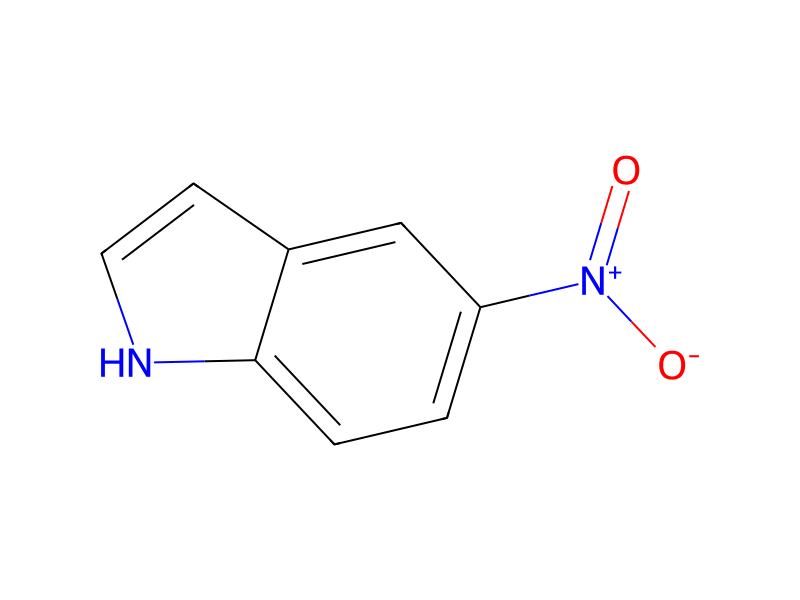
Product 2

Reagents, catalysts & solvents 1

Procedure
To a solution of 5-nitroindole (5.00 g, 30.8 mmol) in pyridine (200 mL) at −4° C. is added a solution of pyridinium bromide perbromide (10.99 g, 34.3 mmol) in pyridine (200 mL) dropwise under nitrogen with stirring. After complete addition, the reaction mixture is stirred for 5 min at 0° C. The reaction mixture is diluted in 0° C. water (200 mL) and extracted with 200 mL of Et2O. The organic layer is washed with 6 M HCl (300 mL), 5% NaHCO3 (300 mL), and brine (300 mL). The organic phase is dried over MgSO4 and solvent is removed to give 3-bromo-5-nitroindole as a yellow powder, 80% pure with 20% 5-nitroindole (6.80 g, 74% yield).
Workup
- additionAfter complete addition
- stirringthe reaction mixture is stirred for 5 min at 0° C
- extractionextracted with 200 mL of Et2O
- washThe organic layer is washed with 6 M HCl (300 mL), 5% NaHCO3 (300 mL), and brine (300 mL)
- dry with materialThe organic phase is dried over MgSO4 and solvent
- customis removed
Sources & evidence
- ORD record
- ord-86ce15580b554b899bb5f41cd92f48bc
- Source dataset
- uspto-grants-2011_01
- Patent number
- US07868037B2
Reaction notes
Loading…