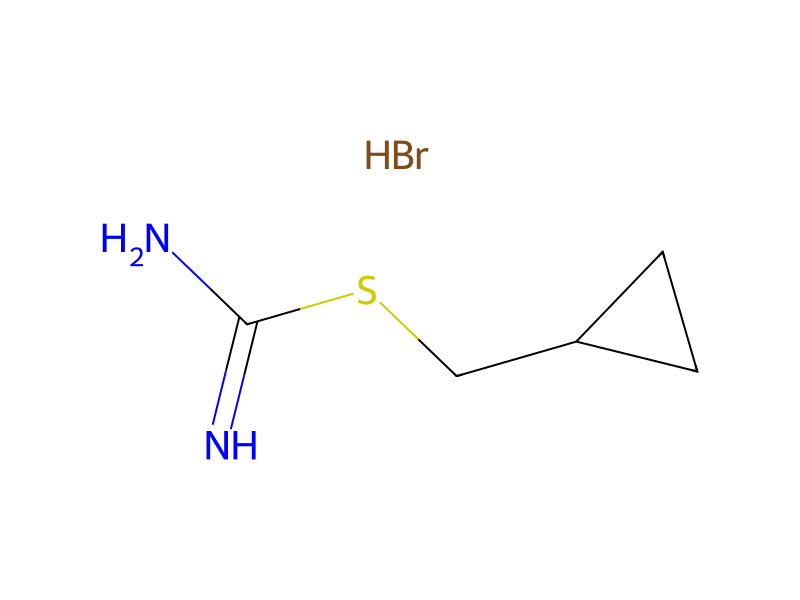
[(Cyclopropylmethyl)sulfanyl]methanimidamide hydrobromide → 4-(5-Chlorothiophen-2-yl)-2-cyclopropylmethylthiobenzonitrile
Reaction equation

[Cl:1][C:2]1[S:6][C:5]([C:7]2[CH:14]=[CH:13][C:10]([C:11]#[N:12])=[C:9](F)[CH:8]=2)=[CH:4][CH:3]=1.Br.[CH:17]1([CH2:20][S:21]C(=N)N)[CH2:19][CH2:18]1>>[Cl:1][C:2]1[S:6][C:5]([C:7]2[CH:14]=[CH:13][C:10]([C:11]#[N:12])=[C:9]([S:21][CH2:20][CH:17]3[CH2:19][CH2:18]3)[CH:8]=2)=[CH:4][CH:3]=1Participants
3


Procedure
0.9 g (4.0 mmol) of 4-(5-chlorothiophen-2-yl)-2-fluorobenzonitrile and 0.9 g (4.3 mmol) of S-cyclopropylmethylisothiourea hydrobromide were allowed to react in the same manner as described above in Example 8 (4), and purification of the crude product by silica gel icolumn chromatography afforded 1.1 g of 4-(5-chlorothiophen-2-yl)-2-cyclopropylmethylthiobenzonitrile (yield 91%) as yellow feathery crystals (m.p. 123-124° C.).
Workup
- customto react in the same manner
Sources & evidence
- ORD record
- ord-3cbd7954f4564b5384156c062acfcfe8
- Source dataset
- uspto-grants-2005_02
- Patent number
- US06858639B2
Reaction notes
Loading…