Hydrochloric Acid → 3,5-Dichloro-2,6-difluoro4-hydroxymethylpyridine
Reaction equation
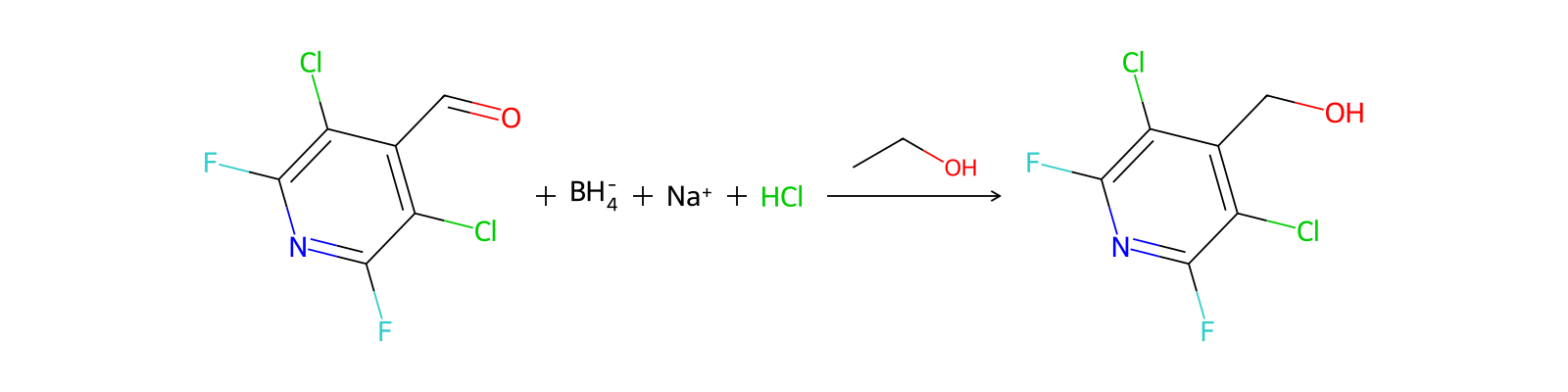
[Cl:1][C:2]1[C:3]([F:12])=[N:4][C:5]([F:11])=[C:6]([Cl:10])[C:7]=1[CH:8]=[O:9].[BH4-].[Na+].Cl>C(O)C>[Cl:10][C:6]1[C:5]([F:11])=[N:4][C:3]([F:12])=[C:2]([Cl:1])[C:7]=1[CH2:8][OH:9]Participants





Conditions
- Temperature
- 0 °C
Procedure
To a mixture of 5.0 g (0.024 mole) of 3,5-dichloro-2,6-difluoropyridine-4-carboxaldehyde (from Step B) in 100 ml of ethanol that had been cooled to 0° C. was added slowly 1.4 g (0.037 mole) of sodium borohydride. After complete addition the reaction mixture was allowed to warm to room temperature and was stirred for approxmately seventeen hours. The reaction mixture was quenched with a stoichiometric amount of glacial acetic acid, and the ethanol was evaporated under reduced pressure, leaving a residue. This residue was mixed with dilute hydrochloric acid, and this mixture was extracted with diethyl ether. The combined extracts were washed repeatedly with a 5% aqueous solution of sodium bicarbonate. The extract was dried over anhydrous sodium sulfate and filtered. The solvent was evaporated under reduced pressure, leaving 3.0 g of 3,5-dichloro-2,6-difluoro4-hydroxymethylpyridine as a residue.
Workup
- additionAfter complete addition the reaction mixture
- temperatureto warm to room temperature
- customThe reaction mixture was quenched with a stoichiometric amount of glacial acetic acid
- customthe ethanol was evaporated under reduced pressure
- customleaving a residue
- extractionthis mixture was extracted with diethyl ether
- washThe combined extracts were washed repeatedly with a 5% aqueous solution of sodium bicarbonate
- dry with materialThe extract was dried over anhydrous sodium sulfate
- filtrationfiltered
- customThe solvent was evaporated under reduced pressure
Sources & evidence
- ORD record
- ord-ecc28e770a9d46748142446d20e39439
- Source dataset
- uspto-grants-1987_10
- Patent number
- US04701464
Reaction notes
Loading…