Vinyl Acetate → 12-Acetoxy-2-chloro-9-formyl-9,10-dihydro-9,10-ethanoanthracene
Reaction equation
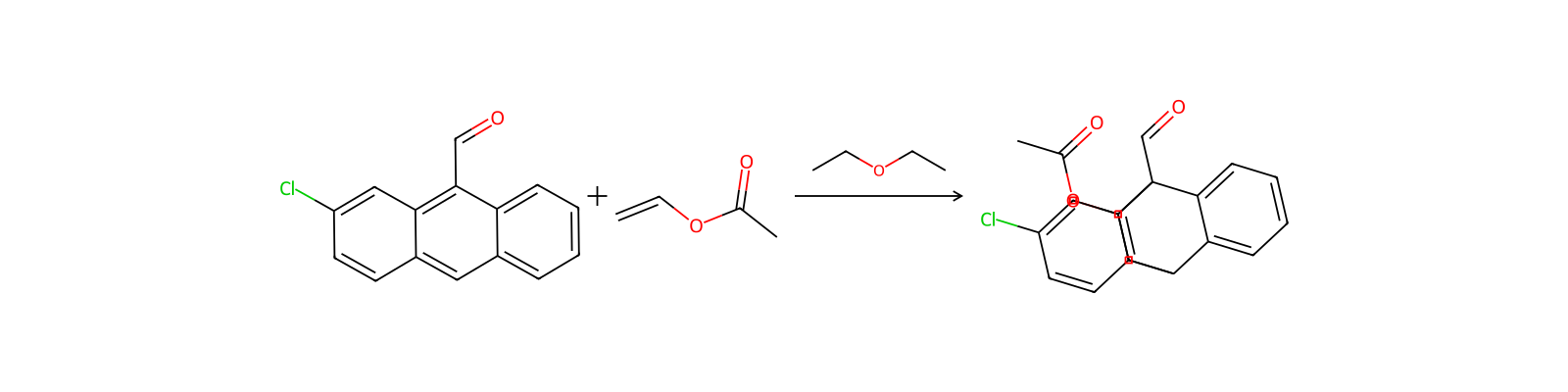
[Cl:1][C:2]1[CH:15]=[CH:14][C:13]2[C:4](=[C:5]([CH:16]=[O:17])[C:6]3[C:11]([CH:12]=2)=[CH:10][CH:9]=[CH:8][CH:7]=3)[CH:3]=1.[C:18]([O:21][CH:22]=[CH2:23])(=[O:20])[CH3:19]>C(OCC)C>[C:18]([O:21][CH:22]1[C:5]2([CH:16]=[O:17])[C:6]3[C:11]([CH:12]([C:13]4[CH:14]=[CH:15][C:2]([Cl:1])=[CH:3][C:4]=42)[CH2:23]1)=[CH:10][CH:9]=[CH:8][CH:7]=3)(=[O:20])[CH3:19]Participants
Reactant 2


Product 1

Reagents, catalysts & solvents 1

Conditions
- Temperature
- 200 °C
Procedure
A mixture of 2-chloro-9-formylanthracene (described in Example 1b) (100.0 g, 0.415 mol) and vinyl acetate (400 ml, 374 g, 4.34 mol) was placed in a stainless steel bomb (PARR) and heated at 200° C. (sand bath temp.) for 24 h, then cooled. The reaction mixture was concentrated on the rotary evaporator to remove the excess vinyl acetate, leaving the crude product as a tan crystalline solid. The crude product from several batches, which consumed 670.0 g (2.78 mol) of the 2-chloro-9-formylanthracene, was pooled. Trituration with diethyl ether (1.0 L) gave an off-white crystalline solid which was collected by filtration, washed with diethyl ether (2×300 ml), then vacuum dried to afford 629.0 g (69.1%) of the title compound (mp 145°-153° C.). NMR (CDCl3) 10.58 (s) and 10.64 (s, 1H), 7.63 (m) and 7.76 (d, J=1.5 Hz, 1H), 7.15-7.36 (m, 6H), 5.46 (m, 1H), 4.29 (s, 1H), 2.55 (m, 1H), 1.88 (s) and 1.91 (s, 1H), 1.55 (m, 1H)
Workup
- temperaturecooled
- concentrationThe reaction mixture was concentrated on the rotary evaporator
- customto remove the excess vinyl acetate
- customleaving the crude product as a tan crystalline solid
- filtrationwas collected by filtration
- washwashed with diethyl ether (2×300 ml)
- customvacuum dried
Sources & evidence
- ORD record
- ord-977872d82e364d038764be874158ea5b
- Source dataset
- uspto-grants-1993_11
- Patent number
- US05266570
Reaction notes
Loading…