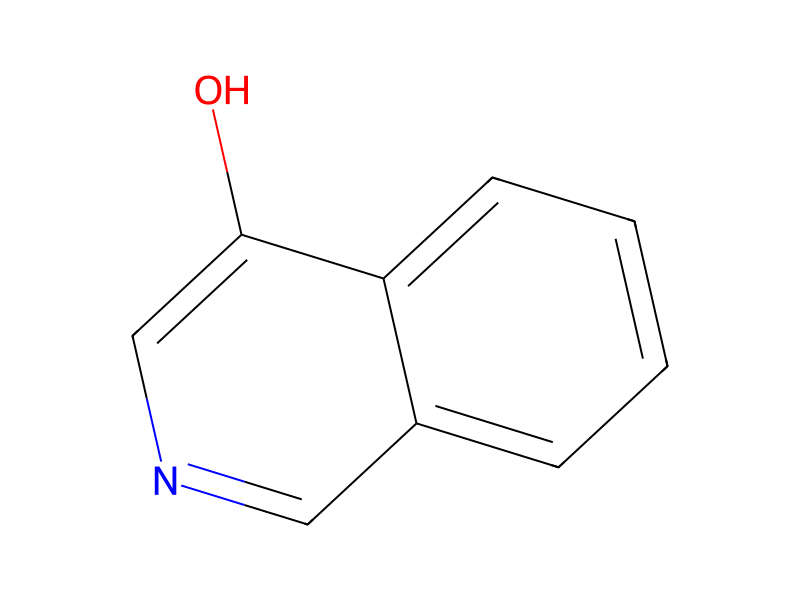
4-Isoquinolinol → HCID 12257649, compound
Reaction equation

[OH:1][C:2]1[C:11]2[C:6](=[CH:7][CH:8]=[CH:9][CH:10]=2)[CH:5]=[N:4][CH:3]=1.[Br:12]Br>[OH-].[Na+]>[Br:12][C:3]1[N:4]=[CH:5][C:6]2[C:11]([C:2]=1[OH:1])=[CH:10][CH:9]=[CH:8][CH:7]=2Participants


Reagents, catalysts & solvents 1

Conditions
- Temperature
- -5 °C
Procedure
6.0 g (41 mmol) of 4-hydroxyisoquinoline are dissolved in 50 ml of 10% strength sodium hydroxide solution, giving a yellowish brown color. The reaction mixture is cooled to -5° C. using an ice/common salt mixture. A mixture comprising 6.6 g (2.1 ml, 41 mmol) of bromine dissolved in 50 ml of 10% strength sodium hydroxide solution is added dropwise to this solution over a period of 1 hour. During this period, the temperature of the reaction solution must never exceed 0° C. After this time, the coolant is removed and the reaction solution is stirred at room temperature for another 3 hours. The reaction solution is then cooled to -10° C. The reaction solution is then brought to a pH of 3 with 2N hydrochloric acid, during which the temperature of the reaction solution never exceeds -5° to 0° C. This gives the crude product as a light yellow solid. The crude product is recrystallized from 180 ml of ethyl acetate.
Workup
- customgiving a yellowish brown color
- additionis added dropwise to this solution over a period of 1 hour
- waitDuring this period
- customnever exceed 0° C
- customAfter this time, the coolant is removed
- temperatureThe reaction solution is then cooled to -10° C
- customthe temperature of the reaction solution never exceeds -5° to 0° C
Sources & evidence
- ORD record
- ord-021813666ec043eebbf6b5bcc7eea84b
- Source dataset
- uspto-grants-1993_11
- Patent number
- US05266700
Reaction notes
Loading…