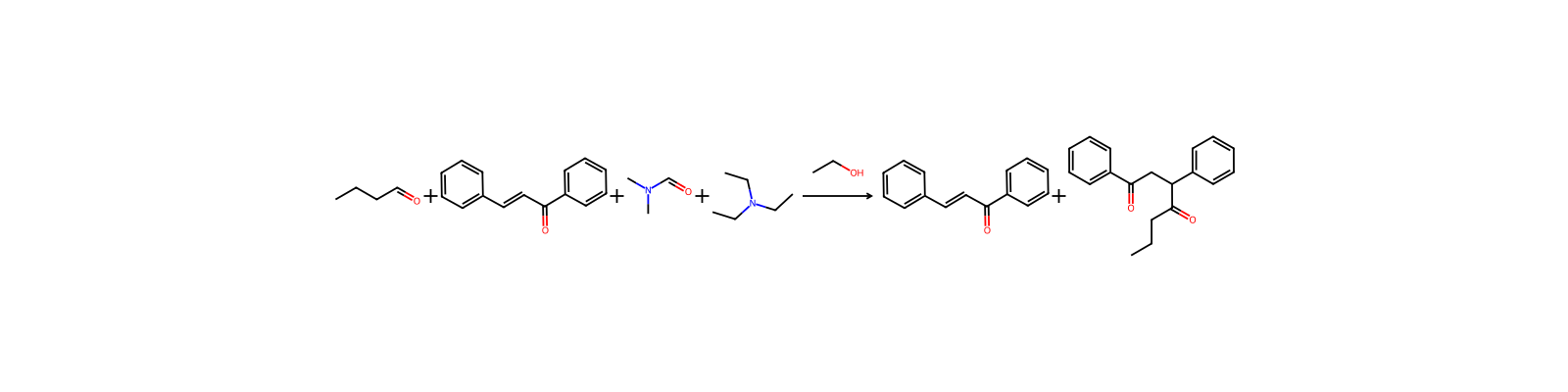
Participants
| Role | Name | HCID | Charge |
|---|
| Reactant | Butanal | HCID 261 | — |
| Reactant | Dimethylformamide | HCID 6228 | — |
| Reactant | Cinnamoylbenzene | HCID 7189 | — |
| Reactant | Triethylamine | HCID 8471 | — |
| Solvent | Ethanol | HCID 702 | — |
| Product | Cinnamoylbenzene | HCID 7189 | — |
| Product | 1,3-Diphenylheptane-1,4-dione | HCID 12288237 | — |
Reaction Steps
Following the description in Example 1, 18 g (0.25 mol) of n-butyraldehyde, 52 g (0.25 mol) of benzylideneacetophenone and 500 ml of dimethylformamide, 250 ml of ethanol and 13.5 g (0.05 mol) of Cat. 1 are -- after addition of 10.1 g (0.1 mol) of triethylamine -- brought to the reflux temperature for 36 hours. To work up the batch, the solvent mixture is distilled off in a waterpump vacuum, the oily residue, when cold, is taken up in 250 ml of chloroform and the solution is washed successively with water, with dilute sodium bisulphite solution and twice more with water. The organic phase is separated off, the chloroform is distilled off and the residue is distilled in an oil pump vacuum. The fraction of boiling point0.2 = 140° - 170° C which is thus obtained is subsequently fractionated through a 30 cm Vigreux column. After a first running of benzylideneacetophenone, 1,3-diphenylheptane-1,4-dione is isolated as the main fraction.
Provenance & Evidence
| DOI | 10.6084/m9.figshare.5104873.v1 |
|---|
| Patent number | US04035395 |
|---|
| Source dataset | uspto-grants-1977_07 |
|---|
| ORD ID | ord-351b6be7b1054901aad685f1af361849 |
|---|
| Source note | uspto-grants-1977_07 |
|---|