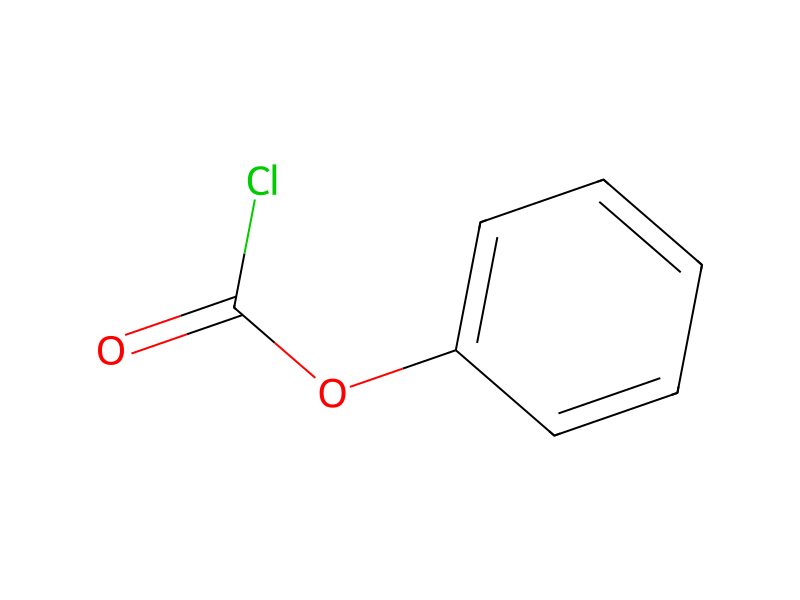
Phenyl chloroformate → Phenoxycarbonyl-4-chloro-3-(2-nitro-3-chlorophenyl)pyrazole
Reaction equation

Cl[C:2]([O:4][C:5]1[CH:10]=[CH:9][CH:8]=[CH:7][CH:6]=1)=[O:3].[Cl:11][C:12]1[C:13]([C:17]2[CH:22]=[CH:21][CH:20]=[C:19]([Cl:23])[C:18]=2[N+:24]([O-:26])=[O:25])=[N:14][NH:15][CH:16]=1>N1C=CC=CC=1>[O:4]([C:2]([C:16]1[NH:15][N:14]=[C:13]([C:17]2[CH:22]=[CH:21][CH:20]=[C:19]([Cl:23])[C:18]=2[N+:24]([O-:26])=[O:25])[C:12]=1[Cl:11])=[O:3])[C:5]1[CH:10]=[CH:9][CH:8]=[CH:7][CH:6]=1Participants
4
Reactant 2

Product 1

Reagents, catalysts & solvents 1

Procedure
1.0 ml of phenyl chloroformate is added, in small portions, to a solution, cooled to 0° C., of 1.3 g of 4-chloro-3-(2-nitro-3-chlorophenyl)pyrazole in 20 ml of pyridine. Stirring is continued for 8 hours at room temperature. The reaction mixture is concentrated to dryness under reduced pressure and taken up in 100 ml of an H2O ethyl acetate (1/1) mixture. The organic phase is dried over MgSO4 and concentrated under reduced pressure. The residual solid is purified by recrystallisation from diisopropyl ether.
Workup
- concentrationThe reaction mixture is concentrated to dryness under reduced pressure
- dry with materialThe organic phase is dried over MgSO4
- concentrationconcentrated under reduced pressure
- customThe residual solid is purified by recrystallisation from diisopropyl ether
Sources & evidence
- ORD record
- ord-a73dc5bf8b3649878b21babaa1881850
- Source dataset
- uspto-grants-1996_06
- Patent number
- US05523280
Reaction notes
Loading…