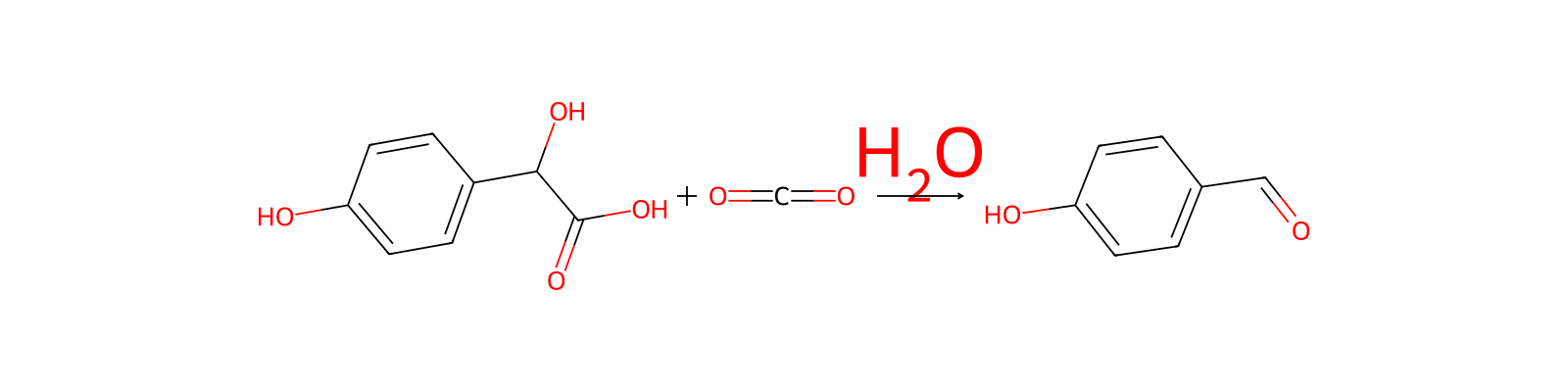
Participants
| Role | Name | HCID | Charge |
|---|
| Reactant | Carbon Dioxide | HCID 280 | — |
| Reactant | (+-)-4-Hydroxymandelic acid | HCID 328 | — |
| Solvent | Water | HCID 962 | — |
| Product | 4-Hydroxybenzaldehyde | HCID 126 | — |
Reaction Steps
9.3 g of 4-hydroxyphenylglycolic acid in the form of the monohydrate (molecular weight 186) are dissolved in 50 g of water, and 82 g of an aqueous 20% FeCl3 solution are added over a period of 20 to 30 minutes at 75° to 80° C., initiating a vigorous evolution of carbon dioxide which stops after another 30 minutes at 100° C. The reaction takes place at a pH-value of from 2 to 0.8. Most of the 4-hydroxybenzaldehyde formed crystallises out of the acid oxidation solution on cooling to 0° C. and is filtered off under suction. The residual 4-hydroxy benzaldehyde is removed from the cold aqueous mother liquor by repeated extraction with benzene. Most of the p-hydroxybenzaldehyde is added to the benzene solution thus obtained, most of the benzene evaporated off and pure 4-hydroxybenzaldehyde precipitated in crystalline form either with light petrol or with cyclohexane.
Provenance & Evidence
| DOI | 10.6084/m9.figshare.5104873.v1 |
|---|
| Patent number | US04163759 |
|---|
| Source dataset | uspto-grants-1979_08 |
|---|
| ORD ID | ord-63a1dda47b1c4ded86ffa844a2e64d72 |
|---|
| Source note | uspto-grants-1979_08 |
|---|